These resources may be of interest to you and your family as you prepare to attend the Italian Renaissance Homeschool Archaeology Camp. Although your child will still learn if they just attend the Dig, many families have found that some preparation helps their child learn more and make connections. Resources are organized into:
Books,
Videos,
online Video clips, Web Quests,
Web Sites and
Picture Books. There is a separate page on
Italian Renaissance Food and
Recipes. This is the background our dig director suggested:
"The Renaissance as it unfolded in Italy was the culmination of developments in art, politics and demography that occurred during the high Middle Ages (13th century AD). Children should be aware that the artistic and political products of the High Renaissance in Italy (1470-1530 AD) rested on events knowable from history, still- existing architecture and copious museum exhibits. The dig focuses on a site from outside the gates of Milan, Italy, which dates to around 1500. The stories they will hear center on the people, events, artifacts and buildings of that period in Lombardy (the region of which Milan was and is the capital) as well as those of Northern Italy and the rest of Europe. In passing, such geniuses as Machiavelli and Vico will be mentioned, as well as scientists like Galilleo, artists like Giotto, Leonardo Da Vinci and Michelangelo, and architects like Bramante and Brunelleschi. Lavishly illustrated slide stories will accompany the verbiage, as well as very detailed and serious maps of the region of concern. The object of the dig is to give the children a grasp of the importance of the period and the region as it can be obtained through correctly-applied archaeological technique and reasoning."
- Geof Purcell, The Archaeological Perspective
(excerpt from private email, September 2006)
Outline of Topics
To me, Big Dog's quote suggests the following discussion items for your children. Of course, every family has their own curriculum plan and interests, and not everyone will be studying this period of history past the dig.
1. Introduction and Culture (time line, geography, culture)
- A bit of Geography
Maps? world – Europe – Italy – Lombardy – Milan
perhaps importance of city walls and city gates
- history?
A bit of timeline – the Renaissance is after the Vikings & Middle Ages, Christianity is well established in Europe. Well before Columbus and electricity. - The Venetian Empire was the seat of economic power in the late Middle Ages and the Renaissance.
(note for parents – The Medicis were a prominent family in the Renaissance – a wealthy family, involved in politics, patrons of the arts, but perhaps not a dynasty that you would want your children to study in detail at this time. I think Machiavelli worked for the Medici. The Renaissance was also known as the “Golden Age of Poison”. This deadly practice helped shape European history and the Catholic Church.)
2. Daily Life (dress, home life, occupations) impacts artifacts that might be found.
By the Renaissance, St. Nicholas was the most popular saint in Europe. One "digger" suggests this virtual Renaissance Village that a school created online. It seems to span countries and many years but has a school, a wedding, complete with photos, the Sistine Chapel and the Globe Theatre. (The Renaissance started in Italy and reached England later.)
3. Religion/Mythology (gods, burial rites, Christianity)
4. Arts and Recreation - Games, Music, Sports, etc.) Games/sports included: Rounders, chess and card games. (lots of pop-ups from this Renaissance Games site)
5. Government, Armies, Class System
6. Language/Writing
Libraries?, Gutenberg, printing press,
7. People (or what do those turtles have to do with this…?)
Genius: Machiavelli, Italian philosopher Giovanni Battista Vico
Scientists:
Galileo Galileo - astronomer and physicist who supported the Copernican theory. (Copernicus was an early scientist who wrote Revolutions of the Heavenly Spheres.)
Johann Gutenburg invented the printing press. He printed the first printed version of the bible.
Artists: Giotto, Leonardo Da Vinci, (Raphael, Michelangelo, Sandro Botticelli (painted the Birth of Venus), Fra Angelico, …)
Architects:
Donato Bramante (1444 – March 11, 1514),
Filippo Brunelleschi (1377 – April 15, 1446) This Florentine architect and engineer was the first to carry out a series of experiments leading to a mathematical theory of perspective.
8. Zooming out for a bigger picture -
- How was this different in different parts of Europe
- Why did the Renaissance start in Flanders and Italy?
- What was happening in the rest of the world?
- How long was the Renaissance? Why did it start in Italy?
- (what period follows – Age of Reason, Enlightenment.
- Where would Shakespeare fall? (this is a question for the oldest children who have or are studying Shakespeare)
For pre-dig days:
Please be ready to give a very brief overview of your craft/presentation's importance to the Renaissance Italians (not a thesis, just a brief history). Pretend Big Dog will be there, ready to say, “What is the context?"
A couple of alerts - In the Renaissance people began to question the church; the church was a bit slow in reacting to scientific discoveries, and some priests were very corrupt. Michelangelo did not lay on his back to paint the Sistine Chapel even though some books and sites still say that. Please use appropriate adult supervision if your family builds things or conducting experiments - even if it is from a source listed here. I accept no responsibility for supervising your children!
Actual Resources
We've listed lots of video clips and web resources this go-around. There has been a lot published on the Renaissance so it's much easier to find things than it was for the Vikings! (Special thanks to Miranda.)
Books
- Eyewitness: Renaissance (Eyewitness Books)
- Journey Through History: Renaissance by Garme Peris, Gloria & Oriol Verges (1988). I would call it a read-to-them picture book, lots of words. I think it makes a good introduction to the period, and give you lots of chance to talk about things. (only caveat: I'm not sure the mention of an "attack by Moslem" is representative.)
- Art for Children: Leonardo DaVinci by Ernst Rabott (ISBN 0-06-446076-2). I especially like that the art work is large enough to see. The series also has books on Michelangelo and Raphael although I have not seen them, all of the others in the series have also been good.
- Amazing Leonardo da Vinci Inventions You Can Build Yourself (Build It Yourself series) by Maxine Anderson (grades 4 - 8 ) how to & history. Please remember appropriate adult supervision when building. (You can get an ebook copy for FREE after registering at wowio.com. Here's their description of the book.)
- Galileo for Kids: His Life and Ideas, 25 Activities (For Kids series) by Richard Panchyk.
- Leonardo da Vinci for Kids: His Life and Ideas, 21 Activities (For Kids series) by Janis Herbert (biography with background on Italy and art) and then 21 activities (grades 4- 8)
- Leonardo, The Beautiful Dreamer by Robert Byrd (grades 3 - 8)
Videos
- PBS – video and related book on Renaissance Lives
- Video: Engineering an Empire - Engineering An Empire: Da Vinci's World
After the fall of Rome, Italy fell into a dark sleep, and wasn't reawakened until the 11th century. Autonomous city-states emerged and these tiny republics began to revitalize their cities and build on a massive level not witnessed since the rise of Rome. In the late 15th and 16th centuries, alliances among various city-states continually shifted as foreign superpowers tried to sink their claws into Italy. The masters who are best known for creating the works of art and architecture of the Renaissance, were also the greatest military and civil engineers of the time. Peter Weller hosts. (See clips online.)
- The History Channel's Da Vinci and the code he lived by: The Unique Vision and Determination of the Renaissance Master. This video seems to have more than was shown on TV.
- The Teaching Company videos can be found at many libraries or purchased. (each title goes on sale at least once a year.) These are courses for high school and college level but usually with entertaining instructors. You may find they are good background for you to watch sharing selected lectures with your family, or you may find this is "too much" now. Relevant videos include: Italian Renaissance, Great Artists of the Italian Renaissance, Art of the Northern Renaissance, Renaissance, the Reformation, and the Rise of Nations, and (New in 2007 & probably not in the libraries - yet) Italians Before Italy: Conflict and Competition in the Mediterranean.
Online Video Clips
Click on the link below for the clips from HISTORY.com.
1. Michelangelo Buonarroti, the greatest of the Italian Renaissance artists, is born in the small village of Caprese on March 6, 1475. The son of a government administrator, he grew up in Flore ...
2. The ceiling of the Sistine Chapel in Rome, one of Italian artist Michelangelo's finest works, is exhibited to the public for the first time. Michelangelo Buonarroti, the greatest of the Ital ...
3. A look at the Palazzo Vecchio and other great palaces in Florence, Italy ...
4. Peter Weller (host) rants about the Renaissance and the birth of Humanism ...
5. Peter Weller (host) visits the Pazzi Chapel, Filippo Brunelleschi's architectural triumph in Florence. ...
Web Quests
1. Renaissance background
http://www.wsu.edu:8080/%7Edee/REN/BACK.HTM
- Renaissance WebQuest by Ms. Bjornstad
http://www.mhrd.k12.nj.us/mk/library/webquests.htm#bjornstad
3. Leonardo da Vinci Web Quest
http://media.nasaexplores.com/lessons/04-065/5-8_2.pdf
- The art of the Italian Renaissance WebQuest
http://teacherlink.ed.usu.edu/tlresources/units/HodgesSpring2005/JackieHirschi/
- Ren. Artists & Inventions Web Quest
http://teacherweb.com/WI/TMS/MrsFry/h0.stm
- Web Quest – Learning about Leonardo
http://library.thinkquest.org/13681/data/davin2.shtml
Web sites
- The Renaissance Connection, from Allentown Art Museum, Allentown, PA
A middle-school level exploration of Renaissance visual arts and innovations and their role in the making of the modern world. As described by their technology partner eduweb on their Adventures Page: " "Explore a timeline of Renaissance art and innovation, commission an artwork as a patron of the arts, design your own innovation, and much more, all enhanced with quirky visuals, irreverent humor, and engaging interactivity that reveal the ways that Renaissance life and culture resemble our own. " (Best if you have Flash installed - but there is a HTML/text version as well.) -
(Victoria & Albert Museum's) At home in Renaissance Italy - listen to music, furnish your own sala, play bingo, …
- Discover the Renaissance - Your Mission is to leap into the life of a character listed below. Find out as much as possible about your character including social status, daily life, talents and occupation.
- Journey Through the Renaissance (although I was not impressed by their projects)
- PBS has a lot from their special Medicis: Godfathers of the Renaissance including a gallery of art , an interactive time line for 1360 - 1743, and pages on artists and Galileo.
- Renaissance Timeline
- Renaissance Theme Page
- The Italian Renaissance (1420-1600)
- Renaissance: Focus on Florence
- Renaissance Influence on Art & Architecture
- Math in Italy
http://www.montana.edu/webquest/math/gradeskto5/howell/italy.html
By using the suggested resources, you will have the opportunity to acquire a better understanding of mathematics through the viewpoint of the Italian culture. Please visit the internet sites and read the accounts of the people and events you will find there. You can pretend to travel back in time and imagine yourself as being there and try to experience Italy and the math they used. -
http://www.twingroves.district96.k12.il.us/renaissance/GeneralFiles/Introduction.html
http://www.craftsforkids.com/projects/600/608.htm
http://www.easyfunschool.com/article1063.html
- Italian Renaissance Art Project - You are part of a group of artists dedicated to understanding Italian Renaissance Art. You will analyze the painting techniques used by Italian painters throughout the Renaissance. Each artist in your group of four will examine the art work.
-
Art of the Renaissance - Links to support lessons in Renaissance Art, including examples of Renaissance music, art, mapping etc., Scholastic's Internet Field Trip, Annenberg Media's Annenberg Media's Renaissance: Out of the Middle Ages and Renaissance: What inspired this age of balance and order?
- Renaissance Ideas from a Parsippany Middle school– geared to 6th grade level
- Italy in Shakespeare’s Times (was this late Renaissance or a next period?) http://ryecityschools.lhric.org/webquest/High/Shakespeare/Life%20In%20Italy.htm
-
Italophiles has 24 depictions of woodcuts from Cesare Vecellio's Renaissance costume book - first printed in 1590.
- Tour: Italian Renaissance Ceramics
http://www.nga.gov/collection/gallery/itacer/itacer-main1.html
- Italian Ren Elementary Lesson Plans – mostly art
(note: Michelangelo built neat scaffolding and did not lie on his back – although Heston did in the movie)
http://members.aol.com/TWard64340/Renaissance.htm
- Raphael
http://simple.wikipedia.org/wiki/Raphael
- Leonardo daVinci
http://en.wikipedia.org/wiki/Leonardo_da_Vinci
Transforming Mona Lisa – and downloadable Mona Lisahttp://www.wyckoffschools.org/eisenhower/teachers/olejarz/digitalimaging/mona/
- Mona Lisa
http://gardenofpraise.com/art17.htm
- Wikipedia on Renaissance Music
(This artist performs Renaissance music on recorder.)
Another site about Renaissance musical instruments.
- Reasonable intro/overviews of Renaissance Personalities
These pages were made by 8th graders in 1997. (I did not read them all!) http://www.yesnet.yk.ca/schools/projects/renaissance/
- Brunelleschi (architect)
http://www.yesnet.yk.ca/schools/projects/renaissance/main/brunelleschi.html - Galileo (scientist)
http://www.yesnet.yk.ca/schools/projects/renaissance/main/galileo.html - Donatello (Sculptor)
http://www.yesnet.yk.ca/schools/projects/renaissance/main/donatello.html - Shakespeare (scholar, writer)
http://www.yesnet.yk.ca/schools/projects/renaissance/main/shakespeare.html - Machiavelli
http://www.yesnet.yk.ca/schools/projects/renaissance/main/machiavelli.html - Mercator
http://www.yesnet.yk.ca/schools/projects/renaissance/main/mercator.html - Descartes
http://www.yesnet.yk.ca/schools/projects/renaissance/main/descartes.html
Picture Books
- Katie And The Mona Lisa by James Mayhew - She falls through a painting to visit the Renaissance.
- Leonardo and the Flying Boy by Laurence Anholt - "slight" picture book but does have some of Leonardo's drawings.
- Leonardo, The Beautiful Dreamer by Robert Byrd (grades 3 - 8)
- Michelangelo's Surprise by Tony Parillo
- Galileo's Treasure Box by Catherine Brighton
- Not sure if the art work in this book reflects Renaissance art or not: I have not seen this one. Mary, The Mother of Jesus by Tomie dePaola “is lovely and quite different from the author’s typical children’s storybook or his saints’ stories. Mary’s life is depicted in fifteen beautifully illustrated segments. In his forward, Tomie de Paola writes, “When I was an art student in 1956, I saw the Giotto frescoes of the life of Mary in the Arena Chapel in Padua, Italy. I knew that some day, I would attempt my own visual version of Mary’s life. I have drawn on scripture, legend and tradition for the praise of Mary, the mother of Jesus.” – Description from http://charlottemason.tripod.com/4realpaola.htm
last updated: 25 September 2007
links valid at the time they were added
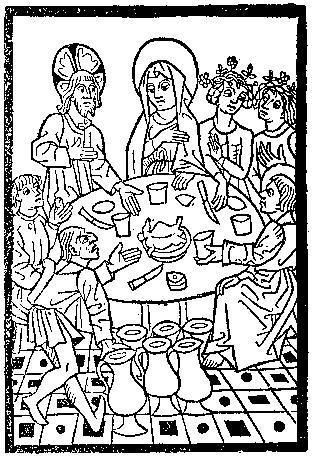 caption: The Marriage at Cana, from the Spiegel menschlicher Behältnis, Basle 1476. From Gode Cookery