worth checking out the sculpture/picture:
http://www.asian-center.net/ancienthistory/ch4.html
18 high resolution photographs of Early Aegean Art in the Metropolitan Museum of Art, includes the Neolithic Era and the Cycladic, Minoan, and Mycenaean cultures. Within modern scholarship, these are loosely considered the precursors to Classical Greece.
http://multimedialearning.org/presentations/203_AegeanCivilization.php
Showing posts with label dig. Show all posts
Showing posts with label dig. Show all posts
Tuesday, May 17, 2011

Sunday, May 15, 2011
Do the Dig: The Neolithic Aegean
There are places left in the archaeology dig led by professional archaeologist "Big Dog" Geof Purcell that Mary Ann O'Rourke is hosting at their farm in Califon, NJ (near where 287 & 78 cross in NJ).
(It's a brand new scenario, for those of you who have attended previous digs...!) If you have not heard of The Archaeological Perspective's digs it is a week camp where students get to do real archaeology in a kid way. These are real scenarios, real artifacts, and real thinking to figure it out. Dig in the morning & see slides & play games (like "Settlers of Catan" to reinforce the concepts in the afternoon. Friday is a "museum", students telling the story & a themed potluck.) This one is timed so that homeschoolers & "brick & mortar" students can both attend. You can make it be as big a part of the your kid's education as you want.
Download registration forms from:
http://www.thinktank-nj.com/archaeology-in-tewksbury.html
Best site I have found for recipes is http://www.culture.gouv.fr/culture/arcnat/chalain/en/recet_acc.htm "Some recipes are quite familiar to modern palates, such as meat cooked on hot stones, smoked filet of trout and grilled frogs." and "... the far less appetizing category of gruels and hotpots."
June 28-July 1, Tuesday - Friday, 10am - 3pm
The theme this year is "The Neolithic Aegean".(It's a brand new scenario, for those of you who have attended previous digs...!) If you have not heard of The Archaeological Perspective's digs it is a week camp where students get to do real archaeology in a kid way. These are real scenarios, real artifacts, and real thinking to figure it out. Dig in the morning & see slides & play games (like "Settlers of Catan" to reinforce the concepts in the afternoon. Friday is a "museum", students telling the story & a themed potluck.) This one is timed so that homeschoolers & "brick & mortar" students can both attend. You can make it be as big a part of the your kid's education as you want.
Download registration forms from:
http://www.thinktank-nj.com/archaeology-in-tewksbury.html
Best site I have found for recipes is http://www.culture.gouv.fr/culture/arcnat/chalain/en/recet_acc.htm "Some recipes are quite familiar to modern palates, such as meat cooked on hot stones, smoked filet of trout and grilled frogs." and "... the far less appetizing category of gruels and hotpots."
- Acorns, anyone?
- Bear's garlic salad?
- Flattened cakes of bread?
- elder berries?
- Filet of trout?
- honey?
- Dig groups have always been very forgiving - if you want to bring more modern beautiful fish stew, or Aegean shrimp salad or other Greek recipes I am sure it would be eaten! There are usually at least one vegetarian and some food allergy, so check during the week, and please label food ingredients. If you are camping out to attend the dig (real camping or at a local friend/relative/hotel) we will also need drinks, etc. so just be the one to sign up early for those things. (or, if you found a local bakery with baklava, I'm sure that everyone would love you.)
Friday, June 18, 2010
FAQ for "Do the Dig"
Let students do "adult stuff in a kid way" with archaeology.
The Archaeology Perspective (T.A.P.) comes to a number of locations in New York, New Jersey and PA. Geof "Big Dog" Purcell has also done digs in Maryland, and probably CT/RI. Upcoming digs closest to me include:
- Aegean June 2011, Califon, NJ (new dig topic)
- NAI early America - Spring 2011 - Orange County Homeschoolers, NY
- (Roman) Egypt : Tuesday - Friday starting October 4th, 2010 near Blairstown. If you have any questions or are interested in participating please email Natashia for a headcount.
- China - Fall 2010 - Orange County Homeschoolers, NY
- Ancient India - last week of June 2010 (new dig topic!)
" India! A cradle of civilization! What will you find? The remains of 5000 year old
Harrapan cities? An early Hindu Temple (c.500 BC)? A Buddhist shrine (c.200 AD)? The garbage of a house (1850 AD)? It could be all of the above as we dig into the mysterious culture, geography and history of the sub-continent!"
A fun filled week of being able to dig for and find amazing artifacts and learn something new about different countries, geography, philosophy, ancient cultures, remains, and people. The children will also learn to solve on site archaeological puzzles for the dig they are doing.
The attending campers are encouraged and learn, with the guidance of Big Dog, to develop an interpretation and be able to present archaeological evidence from their dig by excavating the site in such a way as to maximize the preservation of information embedded in the context and embodied in the artifacts.
The participants will have a picture of what professional archaeologists do, how they do it, and perhaps why it matters, by determining:
- What are the artifacts? how were they used?
- How were they made? what resources used,
- What is the context of the artifacts? ("in the dirt", "in a bowl"?) how did they get here? (were they lost? hidden? or thrown away?)
- the problem to be solved: how we identify and interpret artifacts and their context, (was this made locally? are the resources local or were they acquired by trade? or war?)
- ways to solve them: by staring, digging, processing, questioning, and
- displaying the artifacts and explaining what was found creating exhibits.
The students will be led through questions like "How we know what we know about the past?" and learn to make crucial distinctions between different kinds of meaning by digging, thinking, exhibiting, and explaining artifacts.
Q: Who runs the camps?
Geof Purcell, a.k.a. Big Dog, Professor of Archaeology and a world renowned archaeologist decide several years ago that children would immensely benefit from the hands-on experience of what it's like to be an archaeologist. Mr. Purcell then created TAP-The Archaeological Perspective- to bring archaeology and children together.
Q: How long is the homeschool (day) camp?
Tuesday through Friday.
usually 10 am to 4 pm for the full day, children ages 7 and up, and 10 am to 1pm for half day campers, ages 5 to 7. (Note: Some camps run from 9 am to noon/3pm.)
Half day campers go home after lunch. In the afternoon, full day campers participate in playing strategic logical board games, which coincide with what they are learning in camp.
If you don't think your child would be ready for a full day program, or your schedule doesn't allow for it, it's perfectly alright just to participate in the half day program.
Children will "dig" mornings Tuesday through Thursday, with breaks for discussion, and their bag lunch. Afternoons are devoted to discussion, slide shows & games which re-enforce the concepts presented. They might trade resources using a board game, or strategize which expedition to fund in a card game. Friday they will set up a "museum", thinking about what they have seen & found, and the stories they built in their heads. Visitors are encouraged to come, look, and partake in the dig themed potluck.
A certain number of parents must stay at the dig - it is not for Geof & the host to supervise all 24 students! If you leave your child, be sure to leave contact information and, in case of emergency, a medical release with the host. Please inform the host and Big Dog of any allergies or special issues even if you are staying.
Q: What do the children do all day?
The dig site is divided into sections and the children are assigned a square, usually two children per square. They are given papers to map their daily dig and mark down what they find. The digging starts once all the campers have their proper digging tools and Big Dog explains the how, what, why, and where. The artifacts are then discovered, logged and cleaned. The children will also watch a slide show and hear Big Dog tell adventures tales of his travels from all over the world, all of which is tied in with the dig the children are doing.
Q: What is the cost for 2009 homeschool archaeology camp?
$170 for full day campers & $120 for half day campers.
20% discount for siblings.
$50 deposit required per child.
All checks need to be made out to TAP (short for "The Archaeological Perspective")
Q: When do we sign up?
In general, your child's spot will be secured once a deposit is received by the site coordinator. (It might be the host, or another parent volunteer.) You will also need to fill in registration forms. The final payment is usually expected about 3 weeks before the dig.
Wednesday, June 16, 2010
Did the Dig: (Roman) Egypt
Are you ready for the next Egypt dig? Week of October 4th , Tuesday to Friday.
Stop by the Metropolitan Museum of Art & look at the (Roman) Egypt, read some books -- or not. Your kids will still learn a ton from this archaeology (day) camp.
"Do the Dig" in October 2010 at a location in Blairstown, NJ in Warren County.
For more information on the dig please visit Geof's website http://www.dothedig.net . Or, use the labels on the side to see other descriptions. (The Met museum's website is http://www.metmuseum.org/ .
If you have any questions or are interested in participating please email Natashia < kruse@ptd.net > ASAP so she can have a headcount. (There might be spaces in Ancient India dig in Tweksbury... the last week of June.)
Tuesday, March 16, 2010
Ancient India: recipes
Just the start of potluck ideas - so much depends on the era and part of India!
crops: barley, wheat, rice, melons, cotton
domesticated animals: cows, pigs, buffalo, sheep
Many lived near rivers and caught fish with fish hooks.
Main foods: wheat products with barley, or rice, with fish & meat. (wheat grew more in the north & rice more in the south) After Buddhism, probably half the population was vegetarian.
In the Gupta Empire, the diet was vegetables, fruits, cereals, breads, and they drank milk.
These recipes were labeled as from "ancient India". These are mostly from http://www.thewanderingnomad.com/indian_recipe.html
Suji Halva
Ingredients:
1/2 cup suji (semolina)
1/2 cup sugar
1/2 cup ghee
1 1/2 cup water
1 oz sliced almonds
1 oz raisins
8 green cardamoms
Directions: How to Cook Suji Halva (Semolina Halva)
1. Boil sugar and water together for 5 minutes. 2. Heat ghee add suji and stir on a slow fire till mixture becomes light creamy in color and ghee leaves the side of the pan. 3. Add the syrup and stir briskly till it is absorbed in the semolina. 4. Mix crushed cardamom seeds, almonds, and raisins. 5. Serve hot.
crops: barley, wheat, rice, melons, cotton
domesticated animals: cows, pigs, buffalo, sheep
Many lived near rivers and caught fish with fish hooks.
Main foods: wheat products with barley, or rice, with fish & meat. (wheat grew more in the north & rice more in the south) After Buddhism, probably half the population was vegetarian.
In the Gupta Empire, the diet was vegetables, fruits, cereals, breads, and they drank milk.
These recipes were labeled as from "ancient India". These are mostly from http://www.thewanderingnomad.com/indian_recipe.html
DIET BHEL (Healthy Mixture)
½ cup whole green grain sprouts (Mwong)
½ cup sprouted earthen pot (matki)
¼ Cup chopped tomato
1 T plain yogurt
½ tsp cumin seed powder
Fresh, chopped coriander leaves (cilantro)
Salt to taste.
Directions: Mix all ingredients thoroughly and serve.
REFINED WHEAT FLOUR UPMA
1 Cup semolina (cream of wheat is very close)
2 Cup boiled water
¼ Cup each, cabbage and onion
½ tsp cumin seeds
2 tsp green goam (split dal) dal (mwong) soaked for an hour in water
4 – 5 curry leaves
2 tsp oil, 1 tsp sugar, salt to taste.
1 or 2 green chillies (chopped)
Cut coriander leaves
Directions:
1. Roast the semolina in a lightly oiled pan at low temperature until lightly browned. Put into dish and set aside
2. Put small amount oil in same pan, heat and put in curry leaves, cumin seed to crackle, then add chili pieces, cut vegetables and soaked dal and fry until brown.
3. Add roasted semolina, salt and sugar to taste. Mix well
4. Pour boiled water in the mixture, mix well and cover with lid.
Cook over slow heat until liquid is absorbed. Remove from heat, let stand 5 minutes.
Serve with freshly cut coriander leaves and sprinkle with lemon juice.
SPINACH OR FENYGREEK (Frozen Methi) ROTI (PARATHA)
Ingredients:
¼ Cup rice flour
¼ green gram dal flour (Bensan) chama dal flour (ground yellow split peas)
¼ each of jowar and bajra flour
1 ½ cup wheat flour
2-3 tsp oil
a pinch of asafetida (a type of spice)
½ tsp cumin seed powder
¼ tsp turmeric powder
2 tsp white sesame seeds
½ tsp ajwain seeds (also used for upset stomach)
½ tsp ginger paste
Salt to taste
1 cup spinach or fenugreek leaf paste
Directions:
1. Mix all the ingredients slowly in the spinach paste only. Use little water if needed. Make a, somewhat, hard dough and let stand in a covered bowl for half an hour.
2. Make small balls of the dough
3. Roll dough in a flat circle with the help of a little oil. Fold in half and again a triangle with oil.
4. Roll flat again.
5. Roast on a flat pan (tawa) over medium heat.
6. Serve with tomato ketchup, or other topping.
GREEN GRAM DAL SWEET SOOJI (In India, girls start to make semolina halvah when they are about 8 years old. The recipe is very similar.)
Ingredients:
1 cup green gram dal
1 ½ cup sugar
½ cup ghee
1-5 tsp cardamom powder
Directions:
1. Wash and soak the dal in water over-night.
2. In the morning, drain the water and grind dal in mixer.
3. In a hot pan over slow heat, sauté the ground dal in ghee till browned.
4. Add sugar and cardamom powder and mix well until sugar dissolves. Cover and remove from heat. Let stand for 4-5 minutes and serve hot.
VITAMIN SALAD
Ingredients:
½ cup grated cabbage
½ cup green gram sprouts, boiled.
½ cup finely chopped skinned tomatoes.
½ cup skinned and grated beetroot.
½ cup grated carrot
1 medium chopped onion.
½ cup boiled Bengal gram sprouts
1 cup chopped lettuce.
6-7 tablespoons curd, drained.
1 tsp finely chopped ginger.
1-2 chopped green chili.
Fresh, chopped coriander leaves
Salt and pepper to taste
1 tsp sugar
1tsp lemon juice
Directions: Chill all ingredients and mix at time of serving.
CABBAGE SALAD
Ingredients:
1 medium cabbage, grated
1 finely chopped cucumber
1 small finely chopped capsicum
1 chopped onion
½ cup roasted groundnut powder
1 t roasted sesame seeds
1 T lemon juice.
Salt, pepper and red chili powder to taste.
1. Chill all ingredients and mix together well at time of serving.
RAVA UTHAPAM (SEMOLINA PANCAKE)
Ingredients:
2 Cups semolina (Rava)
1 ½ cup curd (plain yogurt)
2 medium onions cut lengthwise.
1 finely chopped skinned tomato, salted to taste
10 tsp oil to make pancake.
½ chopped ginger
1-2 chopped green chili
½ tsp roasted cumin seed powder.
A few fresh chopped coriander leaves.
Directions:
1. Mix all the ingredients in a large bowl, to form a somewhat thick, pouring consistency.
2. Heat skillet. Thinly coat with oil. Cook on both sides until lightly browned.
3. Serve hot with green (coconut and chili or other favorite) chutney.
IDLI (RICE CAKES) – STEAM COOKED
Ingredients:
1 ½ Cup boiled (raw) rice
¾ Cup black gram dal
4 tsp. Oil.
Salt and pepper to taste.
Directions:
1. Soak rice and dal separately in water overnight.
2. Wash drain and grind to a paste separately, then mix together and set aside to ferment for 8-10 hours.
3. Apply a little warm water and salt to taste in the mixture.
4. Steam cook in a thali (flat small dish) for 15 minutes in a rice cooker.
5. Remove the container from cooker, cut the cake in squares and serve hot with green chutney.
MOONG KHICHADI (GREEN RICE) (Microwave)
Ingredients:
1 Cup uncooked rice
1 Cup Moong sprouts (green gram whole)
2-3 pinches asafetida, to taste.
¼ tsp. Turmeric powder
2 tbsp. Ghee
2 tbsp coriander-cumin seeds (roasted)
2 tsp sugar.
1 tsp chili powder.
2 tbsp grated fresh coconut.
2 tbsp chopped fresh coriander
salt to taste.
Directions:
1. Wash the rice and moong sprouts. Drain
2. Put the ghee in a glass bowl and microwave on high for about 30 seconds.
3. add the rice, moong sprouts, asafetida, turmeric powder, spices and 2 ½ cup water.
4. Cover and microwave on high for about 15 minutes. Stirring in between every 5 minutes.
5. Garnish with freshly cut coriander leaves and grated, fresh coconut and serve hot.
Note:
We can make this rice (khichadi) using vegetables like freshly chopped beans, carrots cauliflower, potato, onion, green peas or other sprouted pulses. We may add these in various combinations to make tasty nutritious dishes.
KHICHDI
1C Sago (Sabundana)(looks like Tapioca) -soaked overnight
Wash and soak in ½ C water overnight.
IN the morning add 1 T gee in hot pan. Add 1t cumin seed to crackle
2 Chopped green chilies
Add soaked Sago
½ C roasted crushed peanuts.
Add Salt to taste
Cook for 3-4 minutes over slow heat, stir,
Sweeten to taste.
Suji Halva
Ingredients:
1/2 cup suji (semolina)
1/2 cup sugar
1/2 cup ghee
1 1/2 cup water
1 oz sliced almonds
1 oz raisins
8 green cardamoms
Directions: How to Cook Suji Halva (Semolina Halva)
1. Boil sugar and water together for 5 minutes. 2. Heat ghee add suji and stir on a slow fire till mixture becomes light creamy in color and ghee leaves the side of the pan. 3. Add the syrup and stir briskly till it is absorbed in the semolina. 4. Mix crushed cardamom seeds, almonds, and raisins. 5. Serve hot.
Tuesday, February 16, 2010
Ancient Rome: recipe
Thinking ahead to Fall 2010: This won't be enough information (yet) to produce a pot-luck, but I saw these recipes in On Food and Cooking: The Science and Lore of the Kitchen by Harold McGee. He did not say whether he had tried them - or how they would seem to our tastes.
Apicius who wrote the 1st cookbook in AD 1st or 3rd century had recipes for fried, boiled and "soft" eggs.
Roman Egg Recipes:
Pan-cheese: Take milk and the right pan, mix the milk with honey as for other milk dishes, add 5 eggs for a pint, 3 for a hafl-pint. Mix them in the milk until they make one body, strain into a dish from Cuma, and cook over a slow fire. When it is ready, sprinkle with pepper and serve.
Egg-cake made with milk: Take 4 eggs, a half-pint of milk, a cup of oil, and mix them so that they make one body. Throw a little oil into a thin pan, make it boil, and pour in your preparation. When it has cooked on one side, turn it onto a dish, moisten with honey, sprinkle with pepper, and serve.
last updated: 2/16/10
Friday, February 5, 2010
Ancient Rome Resources
Ancient
http://www.historylink101.com/ancient_rome/ancient_rome_maps.htm
Outline of Roman History
http://www.forumromanum.org/history/index.html
Sunday, November 1, 2009
Prehistoric American Food
It was harder to find information than I had expected.
My favorite site was Prehistoric Texas food.
Also worth checking:
http://www.answers.com/topic/food-producers-in-prehistoric-societies
This might help:
http://www.beanbible.com/
My favorite site was Prehistoric Texas food.
Also worth checking:
http://www.answers.com/topic/food-producers-in-prehistoric-societies
This might help:
http://www.beanbible.com/
Sunday, October 4, 2009
Do You "Dig“ Prehistoric USA?
Geoff “Big Dog” Purcell, a professional archaeologist turned educator, is running a 4 day “dig” for us. Some general questions about the dig are answered in "Do the (next) dig". To read more about what we've done at past hoemschool digs, read older Gryphon Academy posts with the topic "dig". (To learn about how Geof does it in the summer, visit: http://www.dothedig.net/)
What: DIG on Northeast Archaic and Woodland peoples of this area into the Colonial period
Who: Students from 4 or 5 years old to ...14?
When: Tuesday, October 20th to Friday, October 23rd
Full Day: 10am -4pm (cost $170)
Half Day (Mornings for younger students, about 5 - 7 years old): 10am-1pm (cost $120)
Where: at a private property in Warren County, just off of route 80
Children will "dig" mornings Tuesday through Thursday, with breaks for discussion, and their bag lunch. Afternoons are devoted to discussion, slide shows & games which re-enforce the concepts presented. They might trade resources using a board game, or strategize which expedition to fund in a card game. Friday they will set up a "museum", thinking about what they have seen & found, and the stories they built in their heads.
Family and friends are invited for the Friday themed-potluck. (RSVPS required!)
Tuesday, April 21, 2009
Did the Dig - Greece
Be part of the up to 24 lucky NJ & PA students digging at each site. There may be a few spaces left! Come and "do"
with "Big Dog" of The Archaeological Perspective (T.A.P) on
At the dig, children/students will be doing adult stuff in a kid way with a professional archaeologist turned educator from 9 or 10 am each day. 5 - 7 year olds stop at noon and go home after lunch, but older campers stay through the afternoon Tuesday,Wednesday and Thursday for more stories, slides, and games.
Visit T.A.P. website to read more about Camp Activities. Note: The homeschool camps are Tuesday to Friday, with digging on Tuesday, Wednesday and Thursday and an exhibit and themed pot-luck on Friday. For previous comments, see Do the Dig: Middle Kingdom China.
I expect price will remain $170 for full day and $120 for half day. ($50 deposits overdue.)
The Tweksbury dig (starting at 10 am daily), email webmaster@talent-nj.org, or
for the dig in Bushkill, PA, starting at 9 a.m. contact Heather (email runnin43@ptd.net).
March 2009: I moved all of the Friday potluck recipe ideas to a separate Ancient Greek Food entry.
April 2009: There may be a few spaces left. It's OK if you could not do the winter curriculum ($60 for the 3-day series).
Ancient Greece
with "Big Dog" of The Archaeological Perspective (T.A.P) on
April 21 - 24, 2008 in Tewksbury, NJ
- OR -
June 23 - 26, 2008 in Bushkill, PA.
- OR -
June 23 - 26, 2008 in Bushkill, PA.
At the dig, children/students will be doing adult stuff in a kid way with a professional archaeologist turned educator from 9 or 10 am each day. 5 - 7 year olds stop at noon and go home after lunch, but older campers stay through the afternoon Tuesday,Wednesday and Thursday for more stories, slides, and games.
Visit T.A.P. website to read more about Camp Activities. Note: The homeschool camps are Tuesday to Friday, with digging on Tuesday, Wednesday and Thursday and an exhibit and themed pot-luck on Friday. For previous comments, see Do the Dig: Middle Kingdom China.
I expect price will remain $170 for full day and $120 for half day. ($50 deposits overdue.)
The Tweksbury dig (starting at 10 am daily), email webmaster@talent-nj.org, or
for the dig in Bushkill, PA, starting at 9 a.m. contact Heather (email runnin43@ptd.net).
March 2009: I moved all of the Friday potluck recipe ideas to a separate Ancient Greek Food entry.
April 2009: There may be a few spaces left. It's OK if you could not do the winter curriculum ($60 for the 3-day series).
Wednesday, April 1, 2009
Ancient Greek Food
Greek ingredients: olive oil, sugar, butter, sea salt, Greek olives, Greek cheeses, phyllo dough, Greek honey, Greek oregano, lamb, thick strained yogurt, Greek coffee, cucumbers, if a Greek recipe says lettuce it almost always means romaine.
Ancient Greek Recipes: of course this focuses on feasts that the rich had, but it does give a taste of the style of food. A symposium would last hours & hours and start with a glass of wine mixed with honey (oinomelo) and bread. Followed by several appetizers , fresh fruit, meat
phase 2: epidorpion (which now means dessert) several kinds of pies, sweets, dried fruits, nuts, cheese and wine mixed with water.
or, more modern Greek food:
Greek Recipes
More Greek Recipes
Eat Greek Tonight: 180 recipes
Dilled Peas with Peppers - Arakas me Anitho & PiperiesMarinated Bell Pepper Salad or Appetizer
Spanakopita (one recipe or another): Greek Spinach pie (and feta cheese)
Hummus with Tahini - Chickpea & Sesame Dip
Spicy Appetizer Stuffed Peppers with Feta Cheese - Piperies me Tyri
Stuffed Peppers with Bulgur & Basil - Piperies Yemistes me Pligouri
Greek Fisherman's Soup - Kakavia
Greek Lentil Soup
Classic Moussaka with Eggplant
Creamy, Cheesy Baked Pasta with Meat - Pastitsio
Stuffed Cabbage - Lahanodolmathes
Easy Greek Spanakopita (Spanakotyropita) - Spinach Pie with Feta Cheese
Classic Greek Salad
Lamb Burger with olives
Tzatziki (thick yogurt, cucumber, and garlic)
Greek Style - Pork Chops with potatoes in the oven
Chicken with Sweet Red Peppers - Kotopoulo me Kokkines Piperies
Baklava (one recipe, or another): rich, sweet pastry, contains nuts
Greek Jam Tart
Greco-Roman Feast: Roman recipes?
More that may help:
Basics of Traditional Greek Cooking : The basics of cooking the fabulous traditional Greek foods that have become famous around the world are easy to learn and easy to follow.
How to Build a Greek Meal : Although there are certain holiday and/or regional traditions, you can pretty much throw out any preconceived ideas of menu planning.
How Greek Foods are Cooked : The Greek language might make it seem as though dishes are cooked in exotic and unusual ways but cooking methods are actually simple. Learn more.
Ingredients Used in Greek Cooking : What ingredients are used in recipes for the delicious foods of Greece? You may be surprised to find that you already know most of them and either have them in your kitchen pantry or can find them at your local market.
Tuesday, December 30, 2008
9th Annual AIA Archaeology Fair
The 9th Annual AIA Archaeology Fair!
When: Saturday, January 10, 2009 from 10:00am to 3:00pm
Where: Loews Philadelphia Hotel, 1200 Market Street, Philadelphia, PA
Admission: FREE!
Experience the excitement of archaeological discovery with your family!
Write in ancient languages, make a Roman mosaic or an Inca khipu, and be a medieval knight! Archaeologists, museum educators, and historical societies will lead hands-on activities and present exciting demonstrations of ancient technologies. Talk to experts about archaeology, history, and cultural heritage. The Archaeology Fair is fun for all generations, and is very kid-friendly!
Teachers and home-schoolers: this is a great opportunity to collect ideas for classroom projects.
Presenters include:
Bucks County Community College
Dickinson College
Dig and Calliope Magazines
Franklin Pierce University
Milwaukee Public Museum
Museum of Science, Boston
Penn Museum
Penn State University
Pennsylvania Archaeological Council
Philadelphia Museum of Art
Society for Pennsylvania Archaeology
St. Louis Community College
Yale University
Archaeological Institute of America…and many others!
The Archaeology Fair is part of the 110th Annual Meeting of the Archaeological Institute of America—the oldest and largest archaeological organization in North America.
Tuesday, December 2, 2008
Winter Curriculum - Greece
At least two groups in the area are working on Ancient Green with professional archaeologist turned educator, "Big Dog" Geof Purcell. Both will have their Dig weeks in the spring.
Premier season of his winter curriculum is 3 days for $60/child and $100/family. Payment due November 7th.
email the site host so we'll have names, but please mail your checks straight to The Archaeological Perspective.
Tewksbury group: Tuesdays.
Craft day: Jan. 6, 2:30 - 4:30
Game day: March 31st, time tbd
Museum field trip (the MET): December 2nd, 2008
Bushkill group: Classes on Thursdays -- perhaps at the Stroudsburg Library or in Bushkill.
Craft day: Jan. 8th, ~12 - 2 pm (talk to the hostess for times)
Game day: March 26th, ~12 - 2 pm (talk to the hostess for times)
Museum field trip (the MET): December 4th, 2008
Those who wish to participate should send the appropriate amount in a cheque (made payable to "TAP") to: G. Purcell, The Archaeological Perspective, PO Box 38161, Albany, NY 12203-8161. This payment should arrive by November 7, 2008.
Please call or write if you have any questions about the curriculum, framework, content or the Spring digs. Deposits go straight to Geof at The Archaeological Perspective -- but please let the site host know when you do.
Tewksbury site coordinator/host: Mary Ann < maryann.orourke@gmail.com >
SocialStudiesforkids.com's Ancient Greece
Activityvillage.co.uk: Ancient Greece for kids
PBS on The Greeks
http://www.historyforkids.org/
Premier season of his winter curriculum is 3 days for $60/child and $100/family. Payment due November 7th.
email the site host so we'll have names, but please mail your checks straight to The Archaeological Perspective.
Tewksbury group: Tuesdays.
Craft day: Jan. 6, 2:30 - 4:30
Game day: March 31st, time tbd
Museum field trip (the MET): December 2nd, 2008
Bushkill group: Classes on Thursdays -- perhaps at the Stroudsburg Library or in Bushkill.
Craft day: Jan. 8th, ~12 - 2 pm (talk to the hostess for times)
Game day: March 26th, ~12 - 2 pm (talk to the hostess for times)
Museum field trip (the MET): December 4th, 2008
Those who wish to participate should send the appropriate amount in a cheque (made payable to "TAP") to: G. Purcell, The Archaeological Perspective, PO Box 38161, Albany, NY 12203-8161. This payment should arrive by November 7, 2008.
Please call or write if you have any questions about the curriculum, framework, content or the Spring digs. Deposits go straight to Geof at The Archaeological Perspective -- but please let the site host know when you do.
Tewksbury site coordinator/host: Mary Ann < maryann.orourke@
Bushkill site coordinator/
These may help you in teaching Ancient Greece:
http://ancienthistory.mrdonn.org/AncientGreece.html
http://cybersleuth-kids.com/sleuth/History/Ancient_Civilizations/Greece/index.htm
Ancient Greek Cities
Ancient Greek Civilizations
Mr. Dowling's Cradel of Western Civilization
Greek Alphabet
Greek Mythology
Greek Pottery
Encyclopedia of Greek Mythology
Map of Ancient Greece
GreekCulture: Greek Mythology
Mythology of the Constellations
Warhorse Simulations: Historical Commentary on the Peloponnesian War
Ancient GREECE: SPARTA
The Statue of Zeus at Olympia
Colossus of Rhodes
Ancient Greesk: storyforkids.org/learn/greeks/
Suggested for 8th grade & up (but adaptable):
Archaeological institute of American Lesson Plans include:
Lesson Plans: Ancient Cultures includes Greek Vase Painting Project, Costume, Feast & Cargo:
Greek Vase Painting Project
A Greco-Roman Feast: Dining and Reclining
Cargoes from Three Continents: Ancient Mediterranean Trade in Modern Archaeology
SocialStudiesforkids.com's Ancient Greece
Activityvillage.co.uk: Ancient Greece for kids
PBS on The Greeks
http://www.historyforkids.org/
Homework Links: Ancient/Greece
For Older Students:
http://library.thinkquest.org/10805/greece.html
Friday, October 17, 2008
Food from Mali
Especially for those preparing to attend a Mali themed potluck, this may be just enough to get you started. Most of the references are about current eating habits in Mali, and not historical information.
As I hope you would do at any potluck, please bring the list of ingredients and label a dish if it has known allergens or ingredients one might not expect.
From oxfam, "The main foods eaten by a moderately well-off family living in Mali’s capital, Bamako, are rice, millet, sorghum, and beans, cooked as a sort of porridge, served with a meat or fish sauce. A common meal in southern Mali is called tô, a pudding made from pounded millet, served with a sauce of meat or vegetables. In the North, the Songhay and Touareg make thick doughy pancakes served with wild leaves. Tô is also popular in Burkina Faso."
Africa Guide says "The food in Mali is similar to that found in Senegal and other areas of West Africa.
Along the Niger river, fish dishes are popular and include Nile perch (or capitaine) which is either fried or grilled, stewed or baked."
iexplore seems to be more of tourist/traveler information. They say Mali National specialties include La Capitaine Sangha (a kind of Nile perch served with hot chilli sauce, whole fried bananas and rice).
National drinks:
• Malian tamarind and guava juices are delicious.
• A traditional drink is Malian tea which should be drunk in three stages; the first is very strong (‘as bitter as death’); the second is slightly sweetened (‘just like life’); the third is well sugared (‘as sweet as love’). Visitors to Mali may be invited to partake in this tea ritual."
Some Recipes
Sesame Seed & honey sticks
Recommended one a site about Mali: Poulet Yassa (Senegalese chicken with onions)
Recipe Hound has a whole list of recipes, including:
Our (West African, mostly Mali) potluck menu:
As I hope you would do at any potluck, please bring the list of ingredients and label a dish if it has known allergens or ingredients one might not expect.
From oxfam, "The main foods eaten by a moderately well-off family living in Mali’s capital, Bamako, are rice, millet, sorghum, and beans, cooked as a sort of porridge, served with a meat or fish sauce. A common meal in southern Mali is called tô, a pudding made from pounded millet, served with a sauce of meat or vegetables. In the North, the Songhay and Touareg make thick doughy pancakes served with wild leaves. Tô is also popular in Burkina Faso."
Africa Guide says "The food in Mali is similar to that found in Senegal and other areas of West Africa.
Along the Niger river, fish dishes are popular and include Nile perch (or capitaine) which is either fried or grilled, stewed or baked."
iexplore seems to be more of tourist/traveler information. They say Mali National specialties include La Capitaine Sangha (a kind of Nile perch served with hot chilli sauce, whole fried bananas and rice).
National drinks:
• Malian tamarind and guava juices are delicious.
• A traditional drink is Malian tea which should be drunk in three stages; the first is very strong (‘as bitter as death’); the second is slightly sweetened (‘just like life’); the third is well sugared (‘as sweet as love’). Visitors to Mali may be invited to partake in this tea ritual."
Some Recipes
Sesame Seed & honey sticks
Recommended one a site about Mali: Poulet Yassa (Senegalese chicken with onions)
Recipe Hound has a whole list of recipes, including:
- Sweet Millet Fritters (Maasa),
- Chicken and Peanut Stew (Maafe),
- West African Kebabs (steak or liver suggested in the recipe),
- Couscous De Timbuktu (Stew with Dates and Couscous),
- Fried Bean Balls (Akara),
- Malian Fish Stew, and
- Jollof Rice.
Our (West African, mostly Mali) potluck menu:
- beverages: papaya juice, ginger juice & water
- Fried Bean Balls (Akara),
- Pumpkin soup (where is the line between authentic & what our children will eat? the line between easy to make after a long day (step 1: open a can of pumpkin puree) and more authentic (step 1: peel & cook sweet potatoes)?),
- Millet & lentil pilaf,
- Jollof Rice,
- Crunchy cabbage salad,
- Poulet Yassa,
- Sesame Seed & honey sticks,
- Couscous de Timbuktu, and
- dessert: lime cake, coconut pie, bananas.
Saturday, August 2, 2008
Did the Dig - West Africa, October 2008
Up to 24 lucky students will be digging in Tewksbury, NJ with Archaeological Perspectives October 14 - 17, 2008 and learning about Western African Culture (along the Niger River in Mali). They will "do adult stuff in a kid way" with professional archaeologist turned educator "Big Dog" Purcell starting at 10 a.m. each day. 6 & 7 year olds stop at 1 p.m., but older campers stay until ~4 p.m. Tuesday, Wednesday and Thursday. Everyone should plan to stay for a potluck(?) lunch on Friday when we all see their museum exhibits and go home around 2/2:30?.
Visit his website to read more about Camp Activities. Note: The homeschool camps are Tuesday to Friday, with digging on Tuesday, Wednesday and Thursday and an exhibit and themed pot-luck on Friday. For my comments on a previous experience with him, see Do the Dig: Middle Kingdom China.
Registration is ~$170 for full day and $120 for half day. Non-refundable deposits of $25 deposits per child are being accepted for Tweksbury. For that dig signup form and more details, see the TALENT website (Tewksbury Area League for Encouraging and Nurturing Talent).
Expect a post to appear about Mali food & potluck ideas - closer to the dates.
Monday, June 23, 2008
Did the Dig - West Africa
Be part of the up to 24 lucky NJ & PA students digging in Bushkill, PA
with "Big Dog" of Archaeological Perspectives
June 23 - 26, 2008
learning about a piece of Africa.
They'll be doing adult stuff in a kid way with a professional archaeologist turned educator from 9 am each day. 6 & 7 year olds can stop at noon, but older campers stay until ~2 pm Tuesday,Wednesday and Thursday.
Visit his website to read more about Camp Activities. Note: The homeschool camps are Tuesday to Friday, with digging on Tuesday, Wednesday and Thursday and an exhibit and themed pot-luck on Friday. For my comments on a previous experience with him, see Do the Dig: Middle Kingdom China.
I expect it will be about $170 for full day and $120 for half day. Deposits were collected in the fall, the remainder is now DUE to Heather (email runnin43@ptd.net).
Tuesday, May 20, 2008
Did the Dig - Mayans
Up to 24 lucky students will be digging in Tweksbury, NJ with Archaeological Perspectives May 20 - 24, 2008 and learning about the Mayans. They'll be doing adult stuff in a kid way with professional archaeologist turned educator "Big Dog" Purcell from 9 am each day. 6 & 7 year olds can stop at noon, but older campers stay until ~2 pm Tuesday,Wednesday and Thursday.
Visit his website to read more about Camp Activities. Note: The homeschool camps are Tuesday to Friday, with digging on Tuesday, Wednesday and Thursday and an exhibit and themed pot-luck on Friday. For my comments on a previous experience with him, see Do the Dig: Middle Kingdom China.
We're starting to collect Maya resources and think about what Maya food might be for that Friday potluck!
I expect it will be about $170 for full day and $120 for half day. Non-refundable deposits of $25 deposits per child are being accepted for Tweksbury. For that dig signup form and more details on the Mayans in Tewksbury.
Sunday, March 9, 2008
Maya Food
Maize (corn) was the most important crop and a staple of their diet. They also grew sweet potatoes, beans, squash, and yucca and hunted for wild turkey, duck, deer, monkey, and peccary(wild pig) and caught fish. Many living in the Yucatan today have a similar diet.
Only nobility could drink chocolate.
Websites to check:
The Maya Foodtimeline on food and agriculture, Wikipedia on Maya cuisine, and Food of the Maya 300 BC to 900 AD (their only recipe is popcorn!).
Learn more about Corn at Newton's Apple. Video. Ethnobotany Teacher's guide
Recipes online:
Only nobility could drink chocolate.
Websites to check:
The Maya Foodtimeline on food and agriculture, Wikipedia on Maya cuisine, and Food of the Maya 300 BC to 900 AD (their only recipe is popcorn!).
Learn more about Corn at Newton's Apple. Video. Ethnobotany Teacher's guide
Recipes online:
- Maya Recipes including tamales, pumpkin soup, ...
- Maya Recipes from FuegoNeuvo Restaurant (salsa, soups, main dishes & a drink)
- Apple Strudel (what kind of apples did they have?)
Sunday, March 2, 2008
Maya Resources
Suggested Periodical Articles
- "The Maya," Kids Discover, 2003.
- "Mexico," Kids Discover, 2005.
- "Maya: How a Great Culture Rose and Fell," National Geographic, August 2007
Books
- expected - do you have any to recommend?
Videos to Consider
- Conquistadors - PBS series, 4 shows. Four part series on the discovery of the Americas by the Spanish conquistadors and the subsequent fall of the Aztec and Inca empires. (DVD)
- Maya-related videos online Newton's apple. Each also has a teacher's guide with suggested activities:
- Maya Quest on a bike! (associated Science Try-it)
- Ethnobotany video(think corn, Science Try-It)
- Jungle
- Inca Engineering
Web Sites to Explore
- Explore the MesoAmerican World - With interactive map and timeline showing Maya
- The Maya - Websites about the Maya, including a Mayan Game and folktale
- Maya and Inca Webquest - Pointers and information for you to create your own Maya presentation
- Mystery of the Maya - In support of the IMAX film of the same name
- Mayas - small pages of food, agriculture, etc.
Friday, October 12, 2007
Italian Renaissance Food
{{You can go straight to the recipes or view other Renaissance Italy Resources.}}
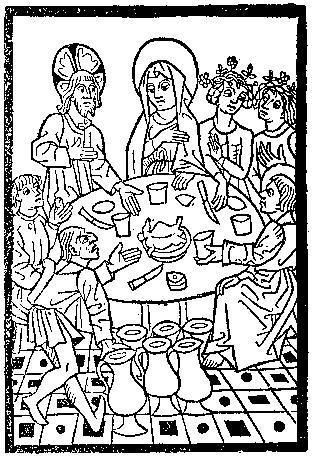 caption: The Marriage at Cana, from the Spiegel menschlicher Behältnis, Basle 1476. From Gode Cookery
What one eats is always influenced by what is available and how much money you have. Renaissance Italy is no exception. I am sure there were significant regional differences – just as there are today, although I can not find any reference to the “olive oil/butter line”. I did find references to olive oil used “for flavor and as a cooking medium”.
Italy
References for this page included:
Victoria & Albert's At Home in Renaissance Italy
Goode Cookery
Thinkquest's library
caption: The Marriage at Cana, from the Spiegel menschlicher Behältnis, Basle 1476. From Gode CookeryWhat one eats is always influenced by what is available and how much money you have. Renaissance Italy is no exception. I am sure there were significant regional differences – just as there are today, although I can not find any reference to the “olive oil/butter line”. I did find references to olive oil used “for flavor and as a cooking medium”.
The Renaissance was a time of “awakening” and changes and food was not exception. Although Marco Polo is unlikely to have gone to
Before refrigeration everyone was much more aware of what was in season and ate fresh when they could, and dried items out of season according to what was available.
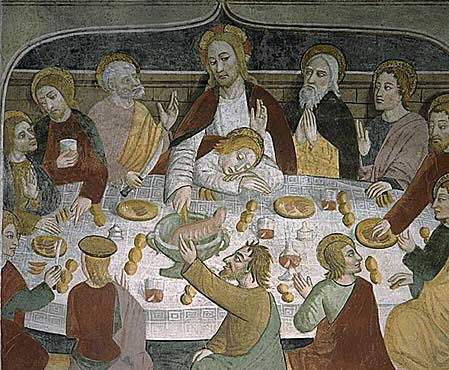
caption: Line illustration and A Last Supper picture from Gode Cookery
Most Europeans were still Catholic and feast/fast days were observed. At one point in the late Middle Ages about half of the days of the year were designated fast days when no meat could be eaten. Of course this was not much of an issue for the poor who could not afford to eat meat as often as every other day! Fish was popular, fresh, dried, and salted, especially in the Lenten season.[2]
Common Foods
Almonds and onions were both very common in general, but I can’t say much about them for- Vegetables
- Bread, pizza (no tomato sauce) & hard biscuits
- The middle class at this time was responsible for the popularity of pasta, lasagna, and ravioli (without tomatoes)[3]
- Soups and stews
- Rice/risotto
- Cheese: including brie, cheddar, gouda, buffalo mozzarella cheese
- Omlettes
- Meatballs, pork, small birds, pike (fish) and game
- Wine (Water was used for coking when it was known to be safe)
Search for Cooking Methods for Vegetables on Gode Cookery's How to cook Renaissance foods for details - but boiling when the water was safe, and eating raw salads were both common. That page also discusses use of water & wine & alcohol, elsewhere the site lists foods to never use for Renaissance cooking like corn, tomatoes, turkey (which had not yet reached them from the New World), rhubarb and bananas (probably know but not used), potatoes, and yams (which traders would bring from Africa). Check out the illustration of a spit from Historic Food.
At Home in Renaissance Italy says “During the Renaissance it was common for meals to have four courses, which could consist of one entrée, two meat courses and one course of fruit or cheese. Meat was expensive and eaten regularly only by the wealthy. Short pasta, which would be boiled, became increasingly popular during the sixteenth century and soon dominated the Italian diet.”
From The Food Timeline
Cuisine of Christopher Columbus
He was born in Genoa where a diet with lots of herbs and salads - but no or few spices and no coffee was common. Read more about cuisine of his Genoa days. Recipes - for his whole life - are here.
Recipes Online
- At home in Renaissance Italy recipes. Note: the recipes are by weight in grams, not cups of ingredients. Got a scale?
- From Gode Cookery: A Renaissance Cookery Book – with recipes ( but in the original…) and the recipes - in the original & “translated” to modern English
- Menu & Recipes from
- French Renaissance Menu: http://saint-esprit.freeservers.com/food.htm
Food of the Renaissance from the Virtual Renaissance Team includes "tidbits" and recipes for breads, cheese & eggs, soups, vegetables (did you know the beginning of autumn was the best season for celery?), staples and desserts. They even have the script of a veggie presentation!
Editure's Renaiassance Food Worksheet
- Renaissance Peas, Sausage, or gingerbread (more like candy)
- Renaissance-style Pasta
- 16th century Italian Carrots in Vinagrette from De Honesta Voluptate et Valetudine by Platina and a Cariota
- 16th century Italian Peach Compote
- 16th century Italian Pear Pie
- Janis Herbert's Leonardo da Vinci for Kids has a recipe for Vegetarian Minestrone (p. 46) and Salai's Aniseed Sweets (p.49). da Vinci probably ate minestrone - but not this one with tomatoes! Spanish explorers brought kidney beans back from Peru in the 15th century so he may have eaten them. While we know that Salai liked anise seed; I am not sure we know if he ate this date sweet recipe. (For more on minestrone, see Richard Calhoun's piece).
References for this page included:
Victoria & Albert's At Home in Renaissance Italy
Goode Cookery
Thinkquest's library
[1] Last week I was told that daVinci was responsible for the “modern” spinning wheel, and he was influenced to do this by information on pulleys – from China. I want to check that out.
[2] Salt was a major trade item, probably from at least the time of Viking invasions. I can’t remember when salt flats were created in Europe.
[3] Remember tomatoes were from the
Subscribe to:
Posts (Atom)