Showing posts with label recipes. Show all posts

Tuesday, April 21, 2009

Did the Dig - Greece

Be part of the up to 24 lucky NJ & PA students digging at each site. There may be a few spaces left! Come and "do"
Ancient Greece

with "Big Dog" of The Archaeological Perspective (T.A.P) on

April 21 - 24, 2008 in Tewksbury, NJ
- OR -
June 23 - 26, 2008 in Bushkill, PA.

At the dig, children/students will be doing adult stuff in a kid way with a professional archaeologist turned educator from 9 or 10 am each day. 5 - 7 year olds stop at noon and go home after lunch, but older campers stay through the afternoon Tuesday,Wednesday and Thursday for more stories, slides, and games.

Visit T.A.P. website to read more about Camp Activities. Note: The homeschool camps are Tuesday to Friday, with digging on Tuesday, Wednesday and Thursday and an exhibit and themed pot-luck on Friday. For previous comments, see Do the Dig: Middle Kingdom China.

I expect price will remain $170 for full day and $120 for half day. ($50 deposits overdue.)

The Tweksbury dig (starting at 10 am daily), email webmaster@talent-nj.org, or
for the dig in Bushkill, PA, starting at 9 a.m. contact Heather (email runnin43@ptd.net).

March 2009: I moved all of the Friday potluck recipe ideas to a separate Ancient Greek Food entry.
April 2009: There may be a few spaces left. It's OK if you could not do the winter curriculum ($60 for the 3-day series).

Friday, October 17, 2008

Food from Mali

Especially for those preparing to attend a Mali themed potluck, this may be just enough to get you started. Most of the references are about current eating habits in Mali, and not historical information.

As I hope you would do at any potluck, please bring the list of ingredients and label a dish if it has known allergens or ingredients one might not expect.

From oxfam, "The main foods eaten by a moderately well-off family living in Mali’s capital, Bamako, are rice, millet, sorghum, and beans, cooked as a sort of porridge, served with a meat or fish sauce. A common meal in southern Mali is called tô, a pudding made from pounded millet, served with a sauce of meat or vegetables. In the North, the Songhay and Touareg make thick doughy pancakes served with wild leaves. Tô is also popular in Burkina Faso."

Africa Guide says "The food in Mali is similar to that found in Senegal and other areas of West Africa.

Along the Niger river, fish dishes are popular and include Nile perch (or capitaine) which is either fried or grilled, stewed or baked.
"

iexplore seems to be more of tourist/traveler information. They say Mali National specialties include La Capitaine Sangha (a kind of Nile perch served with hot chilli sauce, whole fried bananas and rice).

National drinks:
• Malian tamarind and guava juices are delicious.
• A traditional drink is Malian tea which should be drunk in three stages; the first is very strong (‘as bitter as death’); the second is slightly sweetened (‘just like life’); the third is well sugared (‘as sweet as love’). Visitors to Mali may be invited to partake in this tea ritual."

Some Recipes
Sesame Seed & honey sticks

Recommended one a site about Mali: Poulet Yassa (Senegalese chicken with onions)

Recipe Hound has a whole list of recipes, including:
There are some Mali and many more West African recipes at Celtnet.org.

Our (West African, mostly Mali) potluck menu:
  • beverages: papaya juice, ginger juice & water
  • Fried Bean Balls (Akara),
  • Pumpkin soup (where is the line between authentic & what our children will eat? the line between easy to make after a long day (step 1: open a can of pumpkin puree) and more authentic (step 1: peel & cook sweet potatoes)?),
  • Millet & lentil pilaf,
  • Jollof Rice,
  • Crunchy cabbage salad,
  • Poulet Yassa,
  • Sesame Seed & honey sticks,
  • Couscous de Timbuktu, and
  • dessert: lime cake, coconut pie, bananas.

Sunday, March 9, 2008

Maya Food

Maize (corn) was the most important crop and a staple of their diet. They also grew sweet potatoes, beans, squash, and yucca and hunted for wild turkey, duck, deer, monkey, and peccary(wild pig) and caught fish. Many living in the Yucatan today have a similar diet.

Only nobility could drink chocolate.

Websites to check:
The Maya Foodtimeline on food and agriculture, Wikipedia on Maya cuisine, and Food of the Maya 300 BC to 900 AD (their only recipe is popcorn!).

Learn more about Corn at Newton's Apple. Video. Ethnobotany Teacher's guide

Recipes online:
Friends of Big Dog: Don't forget to sign up for your favorite themed food to bring on Friday of the dig!

Friday, October 12, 2007

Italian Renaissance Food

{{You can go straight to the recipes or view other Renaissance Italy Resources.}}

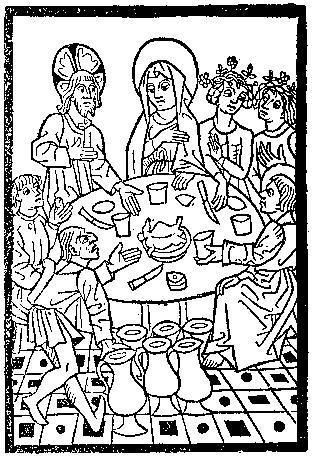
line drawingcaption: The Marriage at Cana, from the Spiegel menschlicher Behältnis, Basle 1476. From Gode Cookery
What one eats is always influenced by what is available and how much money you have. Renaissance Italy is no exception. I am sure there were significant regional differences – just as there are today, although I can not find any reference to the “olive oil/butter line”. I did find references to olive oil used “for flavor and as a cooking medium”.

The Renaissance was a time of “awakening” and changes and food was not exception. Although Marco Polo is unlikely to have gone to China, people did and their influence was seen in many places.[1] One site said that China was responsible for spices, certain stewing/cooking preparations and the custom of eating fruit before a meal. Italians started stewing foods in fruits, wine and spices during the Renaissance. Multi-colored gelatin was seen in Florence - at least at their exclusive cooking academy.

Before refrigeration everyone was much more aware of what was in season and ate fresh when they could, and dried items out of season according to what was available.

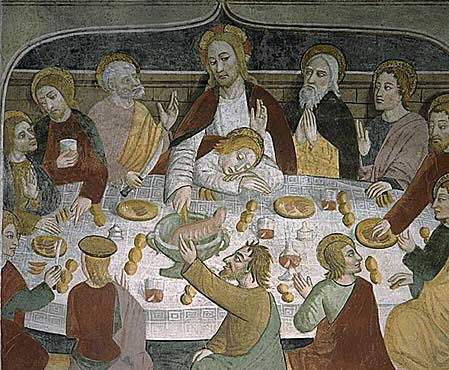
caption: Line illustration and A Last Supper picture from Gode Cookery

picture

Most Europeans were still Catholic and feast/fast days were observed. At one point in the late Middle Ages about half of the days of the year were designated fast days when no meat could be eaten. Of course this was not much of an issue for the poor who could not afford to eat meat as often as every other day! Fish was popular, fresh, dried, and salted, especially in the Lenten season.[2]

Common Foods

Almonds and onions were both very common in general, but I can’t say much about them for Italy in particular. (Please check for food allergies if you are feeding a group!) Common in Italy:
  • Vegetables
  • Bread, pizza (no tomato sauce) & hard biscuits
  • The middle class at this time was responsible for the popularity of pasta, lasagna, and ravioli (without tomatoes)[3]
  • Soups and stews
  • Rice/risotto
  • Cheese: including brie, cheddar, gouda, buffalo mozzarella cheese
  • Omlettes
  • Meatballs, pork, small birds, pike (fish) and game
  • Wine (Water was used for coking when it was known to be safe)

Search for Cooking Methods for Vegetables on Gode Cookery's How to cook Renaissance foods for details - but boiling when the water was safe, and eating raw salads were both common. That page also discusses use of water & wine & alcohol, elsewhere the site lists foods to never use for Renaissance cooking like corn, tomatoes, turkey (which had not yet reached them from the New World), rhubarb and bananas (probably know but not used), potatoes, and yams (which traders would bring from Africa). Check out the illustration of a spit from Historic Food.

At Home in Renaissance Italy says “During the Renaissance it was common for meals to have four courses, which could consist of one entrée, two meat courses and one course of fruit or cheese. Meat was expensive and eaten regularly only by the wealthy. Short pasta, which would be boiled, became increasingly popular during the sixteenth century and soon dominated the Italian diet.”

From The Food Timeline

Cuisine of Christopher Columbus
He was born in Genoa where a diet with lots of herbs and salads - but no or few spices and no coffee was common. Read more about cuisine of his Genoa days. Recipes - for his whole life - are here.

Recipes Online

I also enjoyed reading "What Foods are Period When?" by Marieke. Although I was confused by her referring to Protestants in Medieval Times - since they did not exist until the Renaissance in Italy (while it was still "High Middle Ages" elsewhere).

References for this page included:
Victoria & Albert's At Home in Renaissance Italy
Goode Cookery
Thinkquest's library


[1] Last week I was told that daVinci was responsible for the “modern” spinning wheel, and he was influenced to do this by information on pulleys – from China. I want to check that out.

[2] Salt was a major trade item, probably from at least the time of Viking invasions. I can’t remember when salt flats were created in Europe.

[3] Remember tomatoes were from the New World and originally thought to be poisonous. Extra credit: tell us when tomatoes arrived in Europe and when people started eating them. Make your own food timeline.

Wednesday, October 3, 2007

Italian Renaissance Resources

These resources may be of interest to you and your family as you prepare to attend the Italian Renaissance Homeschool Archaeology Camp. Although your child will still learn if they just attend the Dig, many families have found that some preparation helps their child learn more and make connections. Resources are organized into: Books, Videos, online Video clips, Web Quests, Web Sites and Picture Books. There is a separate page on Italian Renaissance Food and Recipes. This is the background our dig director suggested:

"The Renaissance as it unfolded in Italy was the culmination of developments in art, politics and demography that occurred during the high Middle Ages (13th century AD). Children should be aware that the artistic and political products of the High Renaissance in Italy (1470-1530 AD) rested on events knowable from history, still- existing architecture and copious museum exhibits. The dig focuses on a site from outside the gates of Milan, Italy, which dates to around 1500. The stories they will hear center on the people, events, artifacts and buildings of that period in Lombardy (the region of which Milan was and is the capital) as well as those of Northern Italy and the rest of Europe. In passing, such geniuses as Machiavelli and Vico will be mentioned, as well as scientists like Galilleo, artists like Giotto, Leonardo Da Vinci and Michelangelo, and architects like Bramante and Brunelleschi. Lavishly illustrated slide stories will accompany the verbiage, as well as very detailed and serious maps of the region of concern. The object of the dig is to give the children a grasp of the importance of the period and the region as it can be obtained through correctly-applied archaeological technique and reasoning."

- Geof Purcell, The Archaeological Perspective
(excerpt from private email, September 2006)

Outline of Topics

To me, Big Dog's quote suggests the following discussion items for your children. Of course, every family has their own curriculum plan and interests, and not everyone will be studying this period of history past the dig.

1. Introduction and Culture (time line, geography, culture)

  • A bit of Geography
    Maps? world – Europe – Italy – Lombardy – Milan
    perhaps importance of city walls and city gates
  • history?
    A bit of timeline – the Renaissance is after the Vikings & Middle Ages, Christianity is well established in Europe. Well before Columbus and electricity.
  • The Venetian Empire was the seat of economic power in the late Middle Ages and the Renaissance.

(note for parents – The Medicis were a prominent family in the Renaissance – a wealthy family, involved in politics, patrons of the arts, but perhaps not a dynasty that you would want your children to study in detail at this time. I think Machiavelli worked for the Medici. The Renaissance was also known as the “Golden Age of Poison”. This deadly practice helped shape European history and the Catholic Church.)

2. Daily Life (dress, home life, occupations) impacts artifacts that might be found.
By the Renaissance, St. Nicholas was the most popular saint in Europe. One "digger" suggests this virtual Renaissance Village that a school created online. It seems to span countries and many years but has a school, a wedding, complete with photos, the Sistine Chapel and the Globe Theatre. (The Renaissance started in Italy and reached England later.)

3. Religion/Mythology (gods, burial rites, Christianity)

4. Arts and Recreation - Games, Music, Sports, etc.) Games/sports included: Rounders, chess and card games. (lots of pop-ups from this Renaissance Games site)

5. Government, Armies, Class System

6. Language/Writing

Libraries?, Gutenberg, printing press,

7. People (or what do those turtles have to do with this…?)
Genius:
Machiavelli, Italian philosopher Giovanni Battista Vico

Scientists:
Galileo Galileo - astronomer and physicist who supported the Copernican theory. (Copernicus was an early scientist who wrote Revolutions of the Heavenly Spheres.)

Johann Gutenburg invented the printing press. He printed the first printed version of the bible.

Artists: Giotto, Leonardo Da Vinci, (Raphael, Michelangelo, Sandro Botticelli (painted the Birth of Venus), Fra Angelico, …)

Architects:
Donato Bramante (1444 – March 11, 1514),
Filippo Brunelleschi
(1377 – April 15, 1446) This Florentine architect and engineer was the first to carry out a series of experiments leading to a mathematical theory of perspective.

8. Zooming out for a bigger picture -

  • How was this different in different parts of Europe
  • Why did the Renaissance start in Flanders and Italy?
  • What was happening in the rest of the world?
  • How long was the Renaissance? Why did it start in Italy?
  • (what period follows – Age of Reason, Enlightenment.
  • Where would Shakespeare fall? (this is a question for the oldest children who have or are studying Shakespeare)

For pre-dig days:
Please be ready to give a very brief overview of your craft/presentation's importance to the Renaissance Italians (not a thesis, just a brief history). Pretend Big Dog will be there, ready to say, “What is the context?"

A couple of alerts - In the Renaissance people began to question the church; the church was a bit slow in reacting to scientific discoveries, and some priests were very corrupt. Michelangelo did not lay on his back to paint the Sistine Chapel even though some books and sites still say that. Please use appropriate adult supervision if your family builds things or conducting experiments - even if it is from a source listed here. I accept no responsibility for supervising your children!

Actual Resources

We've listed lots of video clips and web resources this go-around. There has been a lot published on the Renaissance so it's much easier to find things than it was for the Vikings! (Special thanks to Miranda.)

Books

  1. Eyewitness: Renaissance (Eyewitness Books)

  2. Journey Through History: Renaissance by Garme Peris, Gloria & Oriol Verges (1988). I would call it a read-to-them picture book, lots of words. I think it makes a good introduction to the period, and give you lots of chance to talk about things. (only caveat: I'm not sure the mention of an "attack by Moslem" is representative.)

  3. Art for Children: Leonardo DaVinci by Ernst Rabott (ISBN 0-06-446076-2). I especially like that the art work is large enough to see. The series also has books on Michelangelo and Raphael although I have not seen them, all of the others in the series have also been good.

  4. Amazing Leonardo da Vinci Inventions You Can Build Yourself (Build It Yourself series) by Maxine Anderson (grades 4 - 8 ) how to & history. Please remember appropriate adult supervision when building. (You can get an ebook copy for FREE after registering at wowio.com. Here's their description of the book.)

  5. Galileo for Kids: His Life and Ideas, 25 Activities (For Kids series) by Richard Panchyk.

  6. Leonardo da Vinci for Kids: His Life and Ideas, 21 Activities (For Kids series) by Janis Herbert (biography with background on Italy and art) and then 21 activities (grades 4- 8)

  7. Leonardo, The Beautiful Dreamer by Robert Byrd (grades 3 - 8)

Videos

  1. PBS – video and related book on Renaissance Lives

  2. Video: Engineering an Empire - Engineering An Empire: Da Vinci's World
    After the fall of Rome, Italy fell into a dark sleep, and wasn't reawakened until the 11th century. Autonomous city-states emerged and these tiny republics began to revitalize their cities and build on a massive level not witnessed since the rise of Rome. In the late 15th and 16th centuries, alliances among various city-states continually shifted as foreign superpowers tried to sink their claws into Italy. The masters who are best known for creating the works of art and architecture of the Renaissance, were also the greatest military and civil engineers of the time. Peter Weller hosts. (See clips online.)

  3. The History Channel's Da Vinci and the code he lived by: The Unique Vision and Determination of the Renaissance Master. This video seems to have more than was shown on TV.

  4. The Teaching Company videos can be found at many libraries or purchased. (each title goes on sale at least once a year.) These are courses for high school and college level but usually with entertaining instructors. You may find they are good background for you to watch sharing selected lectures with your family, or you may find this is "too much" now. Relevant videos include: Italian Renaissance, Great Artists of the Italian Renaissance, Art of the Northern Renaissance, Renaissance, the Reformation, and the Rise of Nations, and (New in 2007 & probably not in the libraries - yet) Italians Before Italy: Conflict and Competition in the Mediterranean.

Online Video Clips

Click on the link below for the clips from HISTORY.com.

1. Michelangelo Buonarroti, the greatest of the Italian Renaissance artists, is born in the small village of Caprese on March 6, 1475. The son of a government administrator, he grew up in Flore ...

3/06/1475 - Michelangelo Born


[play video 51 sec

2. The ceiling of the Sistine Chapel in Rome, one of Italian artist Michelangelo's finest works, is exhibited to the public for the first time. Michelangelo Buonarroti, the greatest of the Ital ...

11/01/1512: Michelangelo's Sistine Chapel opens


[play video 1 min 3 secs]

3. A look at the Palazzo Vecchio and other great palaces in Florence, Italy ...

The Grand Tour: The Renaissance Art of Florence


[play video 3 min 46 secs]

4. Peter Weller (host) rants about the Renaissance and the birth of Humanism ...

Engineering an Empire: Peter on Humanism and the Renaissance


[play video 2 min 40 secs]

5. Peter Weller (host) visits the Pazzi Chapel, Filippo Brunelleschi's architectural triumph in Florence. ...

Engineering an Empire: Age of Architects - Pazzi Chapel


[play video 3 min 15 secs]

Web Quests

1. Renaissance background
http://www.wsu.edu:8080/%7Edee/REN/BACK.HTM

  1. Renaissance WebQuest by Ms. Bjornstad
    http://www.mhrd.k12.nj.us/mk/library/webquests.htm#bjornstad

3. Leonardo da Vinci Web Quest
http://media.nasaexplores.com/lessons/04-065/5-8_2.pdf

  1. The art of the Italian Renaissance WebQuest
    http://teacherlink.ed.usu.edu/tlresources/units/HodgesSpring2005/JackieHirschi/

  1. Ren. Artists & Inventions Web Quest
    http://teacherweb.com/WI/TMS/MrsFry/h0.stm

  2. Web Quest – Learning about Leonardo
    http://library.thinkquest.org/13681/data/davin2.shtml

Web sites

  1. The Renaissance Connection, from Allentown Art Museum, Allentown, PA
    A middle-school level exploration of Renaissance visual arts and innovations and their role in the making of the modern world. As described by their technology partner eduweb on their Adventures Page: " "Explore a timeline of Renaissance art and innovation, commission an artwork as a patron of the arts, design your own innovation, and much more, all enhanced with quirky visuals, irreverent humor, and engaging interactivity that reveal the ways that Renaissance life and culture resemble our own. " (Best if you have Flash installed - but there is a HTML/text version as well.)
  2. (Victoria & Albert Museum's) At home in Renaissance Italy - listen to music, furnish your own sala, play bingo, …

  3. Discover the Renaissance - Your Mission is to leap into the life of a character listed below. Find out as much as possible about your character including social status, daily life, talents and occupation.
  4. Journey Through the Renaissance (although I was not impressed by their projects)
  5. PBS has a lot from their special Medicis: Godfathers of the Renaissance including a gallery of art , an interactive time line for 1360 - 1743, and pages on artists and Galileo.

  6. Renaissance Timeline

  7. Renaissance Theme Page
  8. The Italian Renaissance (1420-1600)
  9. Renaissance: Focus on Florence
  10. Renaissance Influence on Art & Architecture

  11. Math in Italy
    http://www.montana.edu/webquest/math/gradeskto5/howell/italy.html
    By using the suggested resources, you will have the opportunity to acquire a better understanding of mathematics through the viewpoint of the Italian culture. Please visit the internet sites and read the accounts of the people and events you will find there. You can pretend to travel back in time and imagine yourself as being there and try to experience Italy and the math they used.
  12. http://www.twingroves.district96.k12.il.us/renaissance/GeneralFiles/Introduction.html

  13. http://www.craftsforkids.com/projects/600/608.htm

  14. http://www.easyfunschool.com/article1063.html

  15. Italian Renaissance Art Project - You are part of a group of artists dedicated to understanding Italian Renaissance Art. You will analyze the painting techniques used by Italian painters throughout the Renaissance. Each artist in your group of four will examine the art work.
  16. Art of the Renaissance - Links to support lessons in Renaissance Art, including examples of Renaissance music, art, mapping etc., Scholastic's Internet Field Trip, Annenberg Media's Annenberg Media's Renaissance: Out of the Middle Ages and Renaissance: What inspired this age of balance and order?

  17. Renaissance Ideas from a Parsippany Middle school– geared to 6th grade level

  18. Italy in Shakespeare’s Times (was this late Renaissance or a next period?) http://ryecityschools.lhric.org/webquest/High/Shakespeare/Life%20In%20Italy.htm
  19. Italophiles has 24 depictions of woodcuts from Cesare Vecellio's Renaissance costume book - first printed in 1590.

  20. Tour: Italian Renaissance Ceramics
    http://www.nga.gov/collection/gallery/itacer/itacer-main1.html

  21. Italian Ren Elementary Lesson Plans – mostly art
    (note: Michelangelo built neat scaffolding and did not lie on his back – although Heston did in the movie)
    http://members.aol.com/TWard64340/Renaissance.htm

  22. Raphael
    http://simple.wikipedia.org/wiki/Raphael

  23. Leonardo daVinci
    http://en.wikipedia.org/wiki/Leonardo_da_Vinci

    Transforming Mona Lisa – and downloadable Mona Lisahttp://www.wyckoffschools.org/eisenhower/teachers/olejarz/digitalimaging/mona/

  24. Mona Lisa
    http://gardenofpraise.com/art17.htm

  25. Wikipedia on Renaissance Music
    (This artist performs Renaissance music on recorder.)
    Another site about Renaissance musical instruments.

  26. Reasonable intro/overviews of Renaissance Personalities
    These pages were made by 8th graders in 1997. (I did not read them all!) http://www.yesnet.yk.ca/schools/projects/renaissance/

  1. Brunelleschi (architect)
    http://www.yesnet.yk.ca/schools/projects/renaissance/main/brunelleschi.html
  2. Galileo (scientist)
    http://www.yesnet.yk.ca/schools/projects/renaissance/main/galileo.html
  3. Donatello (Sculptor)
    http://www.yesnet.yk.ca/schools/projects/renaissance/main/donatello.html
  4. Shakespeare (scholar, writer)
    http://www.yesnet.yk.ca/schools/projects/renaissance/main/shakespeare.html
  5. Machiavelli
    http://www.yesnet.yk.ca/schools/projects/renaissance/main/machiavelli.html
  6. Mercator
    http://www.yesnet.yk.ca/schools/projects/renaissance/main/mercator.html
  7. Descartes
    http://www.yesnet.yk.ca/schools/projects/renaissance/main/descartes.html

Picture Books

  1. Katie And The Mona Lisa by James Mayhew - She falls through a painting to visit the Renaissance.

  2. Leonardo and the Flying Boy by Laurence Anholt - "slight" picture book but does have some of Leonardo's drawings.

  3. Leonardo, The Beautiful Dreamer by Robert Byrd (grades 3 - 8)

  4. Michelangelo's Surprise by Tony Parillo

  5. Galileo's Treasure Box by Catherine Brighton

  6. Not sure if the art work in this book reflects Renaissance art or not: I have not seen this one. Mary, The Mother of Jesus by Tomie dePaola “is lovely and quite different from the author’s typical children’s storybook or his saints’ stories. Mary’s life is depicted in fifteen beautifully illustrated segments. In his forward, Tomie de Paola writes, “When I was an art student in 1956, I saw the Giotto frescoes of the life of Mary in the Arena Chapel in Padua, Italy. I knew that some day, I would attempt my own visual version of Mary’s life. I have drawn on scripture, legend and tradition for the praise of Mary, the mother of Jesus.” – Description from http://charlottemason.tripod.com/4realpaola.htm
last updated: 25 September 2007
links valid at the time they were added

Tuesday, October 2, 2007

Pre-dig Days: Italian Renaissance

Pre-dig Days: Italian Renaissance (for 5 – 12 year olds)

This year we decided to focus on the artists and scientists of the period before the dig. We have found that the more we know, the more we get out of a Dig, although there is lots of be learned if one just walks in too! Here is a possible schedule, of course it would vary with the ages and interests of the people involved.

Day 1 – 10 – 2pm – Art & Artists

Bring your own ‘bag’ lunch. Tentative schedule!

1. Brief introduction to the period – perhaps with a time line and black line maps

2. (?) intro to art & artists – by ?

3. daVinci presentation – by child

create a Mona Lisa off your own with a present day person. For ideas:

  1. Lesson Plan: http://members.aol.com/TWard64340/Renaissance.htm#Leonardo
  2. Mostly questions for you to use: Mona Lisa Images for a Modern World: A Teacher's Guide by Robert A. Baron
  3. Ideas for Mona Lisa Parodies
  4. Upside down Modern Mona (more art/drawing, less really Mona Lisa)

Maybe discuss Davinci’s Mona Lisa – monochromatic, review shading & tinting? How it is the most copies art piece in the world? Mona Art and Mona kids versions to show after.

Mona Lisa painting info (& timeline), landscape/background, more landscape, and about the dress. Or, for more background and what scientists have found on the Mona Lisa, see:

4. Michelangelo presentation – requested

Check out the sonnet Michelangelo wrote about how painful standing on scaffolding and painting the ceiling of the Sistine chapel was

5. Donatello representation – requested

Share additive style sculpture done at home following Tabitha Wards’ Elementary Lesson Plans (distributed in advance) from: http://members.aol.com/TWard64340/Renaissance.htm#Donatello

(Warning – while we like her page, it does repeat a myth about Michelangelo as fact. Despite what C. Heston did in the film, we know that Michelangelo stood to paint the Sistine Chapel, using scaffolding he designed himself. We avoided her “ceiling painting” exercise for didactic reasons.)

6. Other (other artists?, perspective, architecture) Victoria & Alberts has some nice resources on Raphael and his painted designs for tapestries that might help.)

7. Renaissance game (if time permits, but we won't be gambling!)

Day 2 (10 – 2 with lunch break) – Scientists

(with a themed potluck of Italian Renaissance food – sign up in advance.) So, where does one learn about Renaissance Italy food and recipes?

Tentative!

1. Galileo’s work – by ?

Scientific method intro – by child

Display Telescopes made at home and discuss seeing the moon. For ideas, see:
http://amasci.com/amateur/teles.html

I'm disappointed by Home Training Tools' "make a simple telescope" directions, unless you happen to have the right lenses around the house! They sell a kit for $13 with what you need, and individual lenses for a more do-it-yourself approach. I really liked their astrolabe directions - this tool has been around for 1000 years reaching its heyday in 1400-1500.

Activity 1. Re-create Galileo experiments (perhaps acceleration? his experiments with motion?). The group leader may want to consider these links – as well as the space they have and the abilities of their group. Please point out that we don’t really know whether Galileo actually ever dropped cannon balls from the Tower of Pisa!

  1. http://galileo.rice.edu/lib/student_work/experiment95/inclined_plane.html
  2. http://galileo.rice.edu/lib/student_work/experiment96/trajectorybackground.html
  3. Falling Balls – experiment 1
    http://www.materialworlds.com/sims/Galileo/worksheet1.html
  4. Period of a Pendulum – Large Angle
    http://www.explorelearning.com/index.cfm?method=cResource.dspExpGuide&ResourceID=454
  5. Registration is required to access experiments from teachers’ domain – but they have about a dozen based on Galileo:
    http://www.teachersdomain.org/app/search/run_search?terms=galileo

Discussion 2. “other Renaissance discoveries”

"war, armor an& weapons" - by child
"Occupations in the Renaissance" - by child

compass – new to Europe
printing press – new to Europe

presentation on libraries & books of the time – by child
(may include impact of printing press in general, or on religion and authors)

3. Renaissance game (if time)

Tuesday, October 10, 2006

VIKING RESOURCES

VIKING RESOURCES
for our Viking Archaeological Dig in October!


The following is a list of books and websites that may be of interest to you and your family as you prepare to attend Archaeology Camp, or for further research after the camp. The camp will focus on the Vikings in Denmark around 1100. Authorship of this is unclear as so many have given their time & effort to it. Thanks especially to Maryann, Lorna and Robin.
“The main things that kids could bring with them to enhance their understanding and enjoyment of the camp have to do with the broad subjects of geography and history (I'll provide the archaeology). I mean, they should know about the continents and the seven seas, that the "Vikings" originated in Northern Europe, and that we know about them mostly because of what was written down about them, either in sagas, on stone monuments, or in the annals of the peoples they raided.”
- Geof Purcell, The Archaeological Perspective
(excerpt from private email, September 2006)
Our Homeschool resources:

If I were to choose only one book on the Vikings, it would be:
"The Usborne Time Traveler - Viking Raiders."

It's not the best book on the topic, but it's bright and colorful, and packs a lot of information into a brief 32 pages. If you use Sonlight curriculum, you may already have this book, as it was pulled from the larger book "The Usborne Time Traveler" (The older version was "The Usborne Time Travellers Omnibus.") (You may need to search with "travelers" and "travellers," as different spellings were used for different editions.) The Time Traveler book is used in the current Sonlight Core 2 curriculum, and was also used in the old Sonlight Core 1 - Four Civilizations program.

A local Usborne representative recommended these titles: (Please follow the instructions on this link if you want Lorna to fund raise for reducing the cost of future homeschooler archaeological digs for those parents on a tight budget.)
• Who were the Vikings?
• Viking World
• Vikings
• Greek and Norse Legends

• Encyclopedia of World History
• Timelines of World History
• Ancient World
• Encyclopedia of the Ancient World
• The Story of Ships

If you need to contact Jessica, her telephone number is 973-706-8613, and her email address is jjromeo_76@yahoo.com

(non_Osborne) favorite stories:
• Leif the Lucky by Ingri and Edgar Parin D'Aulaire -- The Amazon.com listing for this book describes it as follows: “Considered by some children's book authorities to be the d'Aulaire's finest works, this biography of Leif Erickson, son of Eric the Red, best exemplifies the artist's skill in Norwegian folk art, style, and history. Their well-researched text is lavishly illustrated with Viking rune-like carvings, from the dragon prow of the ship that Leif must hurry to remove, lest it anger the spirits of the land, to the stave churches so unique to Norway. Landscapes depict emerald green fjords against floes of ice and mountains of snow. The grand halls of King Olav Trygvason are ornamented with carvings of Nordic mythical creatures while tame polar bear cubs romp and play. In this setting the young Leif grows to manhood and learns the skills of navigation, sailing his own ship when just a teen from Greenland to Norway. It is on his return journey that he discovers a new land we now know to be Newfoundland. Later he sends settlers there, eventually establishing a colony. His tale is aptly and authentically told in the d'Aulaires's inimitable style. 56 pages”

• D'Aulaires' Book of Norse Myths by Ingri D'Aulaire, Edgar Parin D'Aulaire, and Michael Chabon – Highly recommended. The description from Amazon.com says: “The Caldecott medal-winning d'Aulaires once again captivate their young audience with this beautifully illustrated introduction to Norse legends, telling stories of Odin the All-father, Thor the Thunder-god and the theft of his hammer, Loki the mischievous god of the Jotun Race, and Ragnarokk, the destiny of the gods. Children meet Bragi, the god of poetry, and the famous Valkyrie maidens, among other gods, goddesses, heroes, and giants. Illustrations throughout depict the wondrous other world of Norse folklore and its fantastical Northern landscape.”

• Eric the Red and Leif the Lucky (Adventures in the New World) by Barbara Schiller and Hal Frenck -- This is a short, 43 page biographical account of the lives of Eric the Red and Leif Erikson and tells of Leif Erikson's discovery of North America. It is used in the current Sonlight Core 2 curriculum, and perhaps the old Sonlight Four Civilizations Core 1 curriculum. It's a nice read-aloud for grades K and up, and appears to be written at a 3rd grade reading level.

• Viking It and Liking It by Jon Scieszka (Time Warp Trio Book)

• Leif's Saga: A Viking Tale by Jonathan Hunt -- Amazon.com suggests this book for ages 4-8. 40 pages. Fictionalized account of Leif Eiriksson's famed journey to North America, set in a story-within-a-story framework. Sigrid, a Viking girl, visits her father as he works on his knorr, a small, sturdy ship. He tells her of Eriksson's childhood in Greenland and of his voyages to Helluland, Markland, and Vinland, ending with a description of the oak logs he brought back to Greenland, which were the very logs Sigrid's father is using to build his boat.

• The Children of Odin: The Book of Northern Myths by Padraic Colum, illustrations by Willy Pogany. A collection of Norse myths and legends, featuring gods such as Odin and Thor, as retold by Padraic Colum

• Sword Song by Rosemary Sutcliff -- This is a swashbuckling story of a young Viking swordsman banished from his home for a murder he didn't intend to commit. Sixteen-year-old Bjarni Sigurdson is banished from his settlement for five years, so he hires himself out as a swordsman. He finds adventure during his travels as he proves his worth. The story starts out in Rafnglas, a Viking settlement in part of present-day England. When Bjarni becomes a swordsman-for-hire, he first heads out to Dublin, then attaches himself to various Viking leaders whose raids take him to various locales in the islands west of Scotland. Bjarni’s adventures and near-fatal sea fights make him a man, and he returns to Rafnglas after five years, with a bride, ready for his land-take. 288 pages. Intended for ages 10 and up.

• Favorite Norse Myths by Mary Pope Osborne and Troy Howell -- 14 stories. The reading level is for ages 9-12, but can work as a read-aloud to younger children.

• The Story of Rolf and the Viking Bow (Living History Library) by Allen French(YA) - This book is also available on CD, and follows the story of Rolf, a young bowman in eleventh-century Iceland, as he faces many dangers as he tries to bring to justice the men responsible for his father's death. 240 pages. Listed as a Young Adult title on Amazon.com

• three-time Newberry winner: The Sea of Trolls by Nancy Farmer

Non-fiction books about the Norse/Vikings:

• Everyday life in Viking times (Clues to the Past) by Hazel Martell (grades 3 – 5)

• Life on a Viking Ship (Picture the Past) by Jane Shuter (?ages 4 – 8?)

• Life in a Viking Town (Picture the Past) by Jane Shuter (?ages 4 – 8?)

• Viking Empires by Angelo Forte

• The Vikings by John D. Clare, ed. (Living History Series) The illustrations in this book are photos of European Viking reenactment groups, as well as recreations of actual Viking artifacts.

• Viking by Susan Margeson (Eyewitness Books Series) The illustrations in this book are photos of European Viking reenactment groups, as well as recreations of actual Viking artifacts as well as a few very nice, close up, and detailed pictures of weapons and other items.

• Norse Gods and Heroes by Morgan J. Roberts (Myths of the World Series) The illustrations are a mix of photos of Viking artifacts and prints/woodcuts from Romantic art depicting the Norse gods and myths.

• First Facts about the Vikings by Jacqueline Morley -- a nice little reference book

• The Real Vikings (National Geographic) by Melvin & Gilda Berger

• Food & Feasts with the Vikings by Hazel Mary Martell – Includes some recipes in back. We tried pork & leek soup.

• Growing up with the Vikings by Amanda Purves – Published in 1978, we have learned more about Vikings since this book was published, but it has lots of photos of artifacts and pictures.

• Early life in Viking Times (Clues to the past) by Hazel Mary Martell -- This is an older book, with fewer pictures than many of the other recommended books

• The Vikings (History as Evidence) by Hazel Mary Martell

• Viking News: the Greatest Newspaper in Civilization (History News Series) by Rachel Wright -- This colorful and kid-friendly book is structured similarly to the other books in the series, like The Aztec News and The Greek News. It is a book, but is designed to be read as though it were a daily newspaper from the time period, and it presents history and facts about Viking and Stone Age life. It includes a variety of articles and columns, and even has classified advertisements. Much of the content is intended to be funny, so this isn't exactly a serious history book, but it does contain a surprising amount of solid information and is fun and different way for children to learn about the Vikings. Amazon.com recommends this book for reading level ages 9-12, but since it is only 32 pages long, it could also work as a read-aloud for children who are a bit younger.

Fun and Silly Books with a Viking "feel" to them. They are great fun for the younger set, and even the older kids may enjoy them (even if they won't admit it!)

• How to Train Your Dragon (Hiccup Horrendous Haddock III) by Cressida Cowell (Reading Level: ages 9 - 12)
• Hiccup the Viking Who Was Seasick by Cressida Cowell (Reading Level: ages 4 - 8)
• Hiccup The Seasick Viking by Cressida Cowell (Reading Level: ages 4 - 8) -- I believe this book was also published as "Hiccup, the Viking Who Was Seasick."
• How to Train Your Viking, by Toothless by Cressida Cowell
• How to Speak Dragonese by Cressida Cowell -- Recommended for grades 3-5.

Viking Coloring Books
Geared toward older children and adults, but may be interesting for all ages.

• Myths and Legends of the Vikings by John Lindow -- This coloring book from Bellerophon Books contains line drawings of Viking Age art and artifacts, carefully selected to accompany the brief text retellings of the Norse myths by a noted scholar of the Viking Age.

• Story of the Vikings Coloring Book by A.G. Smith -- This coloring book is from Dover Publications and the illustrations are line drawings adapted from Romantic Revival paintings and book illustrations, rather than actual Viking Age art and artifacts, and the scenes illustrated are mostly of warriors, warfare, and similar subjects.

• Viking Designs by A.G. Smith -- Another Dover publication, this book includes line drawings of Viking art and artifacts.
There are several Viking-related books that are available online, in their entirety. Here are a few options:

• Stories of the Vikings by Mary MacGregor http://www.mainlesson.com/display.php?author=macgregor&book=vikings&story=_contents (Perhaps especially the chapters on “The Vikings At Home”
http://www.mainlesson.com/display.php?author=macgregor&book=vikings&story=home and “Viking Beliefs”
http://www.mainlesson.com/display.php?author=macgregor&book=vikings&story=beliefs )

• The Discovery of New Worlds by M. B. Synge (chapter “The Hardy Northmen”
http://www.mainlesson.com/display.php?author=synge&book=discovery&story=hardy and “How the Northmen Conquered England”
http://www.mainlesson.com/display.php?author=synge&book=discovery&story=conquer )

• Eyewitness to History: The Vikings Discover America, ca. 1,000 http://www.eyewitnesstohistory.com/vikings.htm

• This country of ours; the story of the United States by Henrietta Elizabeth Marshall (1876-) New York, George H. Doran company, 1917. CHAPTER 1
HOW THE VIKINGS OF OLD SOUGHT AND FOUND NEW LANDS http://digital.library.upenn.edu/women/marshall/country/country-I-1.html

Other websites and videos that may be of interest to you:

• A fun website, used in the WinterPromise American Story 1 curriculum, is: http://bbc.co.uk/history/forkids . Click on the Viking and you can explore a Viking village, write a message in Runes on a rune stone, experience a day in the life of a Viking, and play, "Thorkel and the Trading Ship."

• An interesting video selection, also used in WinterPromise American Story 1, is entitled, The Barbarians: The Vikings . This video traces the plunderings and explorations of the Vikings. It shows how Vikings reached Greenland and North America, and even how Christianity affected Viking society.

• The Teaching Company’s High School Level—World History: The Fertile Crescent To The American Revolution has one “chapter” on Vikings, and they offer a Vikings course that is on sale in late August & early September! (Either should be available from some public libraries, check with your own county first) The Viking course description online may help provide some background for parents.

• Vikings: The North Atlantic Saga -- http://www.mnh.si.edu/vikings/ and http://www.mnh.si.edu/vikings/start.html
• PBS – includes link to ½ hour video on Viking village -- http://www.pbs.org/wgbh/nova/vikings/
• PBS suggested links: http://www.pbs.org/wgbh/nova/vikings/resources.html
• Viking 1000 – voyage reenactment – includes an online game --http://www.dougcabot.com/viking%20voyage.html
• Viking Longboat Craft Project -- This is a crafts-related website, and there is a fun and not-too-complex project for creating a Viking Longboat: www.craftsforkids.com/projects/viking_longboat.htm

• Viking Longboat Made from ice Cream Sticks -- This is nothing earthshaking, but is a fun article about the launch of a Viking longboat that was crafted from 15 million popsicle sticks: http://news.bbc.co.uk/1/hi/world/europe/4157182.stm

• Someone’s 5th grade Viking study, includes a list of links/resources -- http://www.cdli.ca/CITE/vikings.htm

Runes:
• http://www.cdli.ca/CITE/v_runes.htm
• http://www.pbs.org/wgbh/nova/vikings/runes.html
• PBS: Write Your Name in Runes
• American Museum of Natural History: Write Your Name in Runes

K12 has a sample 2nd grade lesson on Vikings: http://www.k12.com/curriculum/sample_lessons.html

Another Viking reading list to check: http://www.higgins.org/Programs/vikingreadinglist.pdf

A ton of Viking links are here! -- http://www.hotland.com/vikings/

Another link to all sorts of interesting Viking information: http://www.vikinganswerlady.com

If you are interested in medieval arms, armor, or medieval warfare, this website contains information that may be of interest. PLEASE NOTE: The Viking materials are interspersed with other information, and this is a site that that parents should probably explore for useful information, rather than allowing young children to browse on their own. This particular page is nothing more than a book list, but I haven't had time to review the entire site, and since its focus is on arms, armor, and warfare, I thought it best to post a little word of warning about the possibility of unsuitable content. (Everything may be fine, but I wouldn't take the chance without reviewing it first!) Association for Renaissance Martial Arts --http://www.thearma.org/MedievalList.htm

Miscellaneous "Stuff" about the Vikings:
• Treasure Chests: The Vikings An interactive kit that includes a paperback guide, Viking clay runes, a Viking game called hnefatfl, and a cardboard model to put together. Open the secret drawer to find maps, stickers and cards that demonstrate how to dress like a Viking, illustrate the Viking territory, and show the hierarchy of gods and goddesses. Comes with lock and key. Recommended for ages 8-12.

• Giant's Cauldron Viking Myths Odds Bodkin will entrance you with his thunderous voice and 12-string guitar. Get swept up in Norse mythology as this talented storyteller brings characters such as Thor the Thunderer & Odin the Allfather to life. Available on cassette; Approx. 1 hour in length.

• Websites with Viking Clip Art: http://www.osterholm.info/vikings/ and http://classroomclipart.com/cgi-bin/kids/imageFolio.cgi?direct=History/Vikings